







What's Happening?
BRICS countries are actively developing an independent payment infrastructure and expanding industrial cooperation, as stated by Russian Minister of Economic Development Maksim Reshetnikov at the Russia–Africa Economic and Humanitarian Forum in Moscow.
This initiative aims to create tools to attract investment and foster economic growth among member states. For African nations, BRICS is positioned as both an open market and a supplier of technology, industrial goods, and investment products. Key instruments under development include an Association of Special Economic Zones and a Grain Exchange. Additionally, the industry ministries of BRICS member states have proposed establishing a dedicated track for the digitalization of industry and technology access. South Africa, Egypt, and Ethiopia are currently full members of the BRICS grouping. Elias Monage, Chairman of the South African Chapter of the Russia–South Africa Business Council, highlighted potential joint projects in infrastructure, transport, logistics, energy, and cybersecurity.
Why It's Important?
The development of an independent payment infrastructure by BRICS nations signifies a strategic move to reduce reliance on existing global financial systems, which are largely dominated by Western powers. This could offer member countries, including the three African members, greater financial autonomy and resilience against geopolitical pressures or sanctions. By fostering industrial cooperation and providing access to technology and investment, BRICS aims to stimulate economic diversification and industrialization in African countries. This initiative could lead to significant shifts in global trade patterns, potentially increasing South-South cooperation and creating new economic blocs. The focus on infrastructure, energy, and cybersecurity projects addresses critical development needs in Africa, offering alternatives to traditional development partners and potentially accelerating economic growth and regional integration. The emphasis on digitalization of industry could also help bridge technological gaps and enhance productivity across these economies.
What's Next?
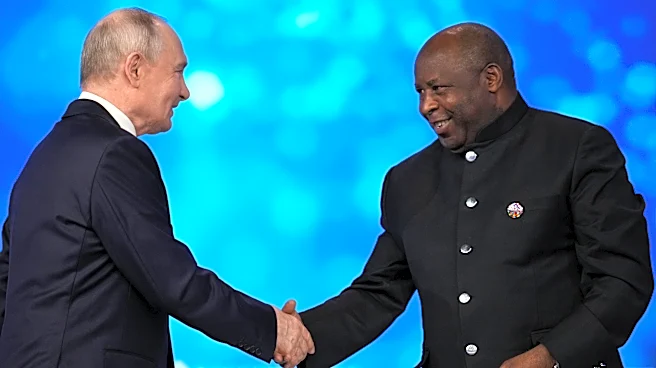
The ongoing development of an independent payment infrastructure and the proposed initiatives like the Association of Special Economic Zones and the Grain Exchange are expected to progress, with further details likely to emerge from future BRICS and Russia-Africa summits. The establishment of a dedicated track for the digitalization of industry and technology access will likely lead to concrete projects and partnerships between BRICS members and African nations. Discussions on joint projects in infrastructure, transport, logistics, energy, and cybersecurity are anticipated to continue, potentially resulting in new agreements and investments. The third Russia-Africa Summit, co-chaired by Putin and Burundi’s President Évariste Ndayishimiye, will serve as a platform for further discussions and potential agreements on these and other areas of cooperation, with delegations from 48 African countries participating.
Beyond the Headlines
This initiative by BRICS extends beyond immediate economic benefits, signaling a broader geopolitical realignment. By offering an alternative to Western-dominated financial and technological frameworks, BRICS is challenging the existing global order and promoting a multipolar world. The emphasis on non-hierarchical and consensus-based approaches within BRICS, as highlighted by Russia, aims to resonate with countries seeking greater sovereignty and less external influence. This move could empower African nations to diversify their international partnerships and reduce their vulnerability to the conditionalities often associated with aid and investment from traditional Western donors. The long-term implications could include a more fragmented global financial system, increased competition among global powers for influence in Africa, and a potential acceleration of economic development in participating African countries through tailored cooperation models.