





What's Happening?
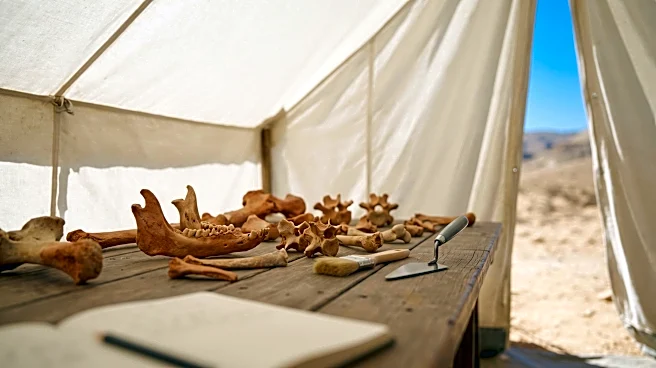
Melina Seabrook, a PhD recipient in anthropology from Harvard, is conducting research into the historical relationships between humans and animals within the early urban centers of Mesopotamia and Iran. Her work focuses on understanding how animals were
integrated into daily life in ancient cities, moving beyond traditional views that often separate animals from urban environments. Seabrook utilizes faunal analysis, which involves studying animal bones, and micromorphology, a technique that examines soil samples under a microscope to identify traces of animal activity like heavy traffic or dung. Her research at sites such as Ur and Tepe Yahya aims to reveal the complex and often interdependent connections between ancient urban populations and the animal kingdom, highlighting the central role animals played in various aspects of life, from sustenance to fuel and materials.
Why It's Important?
This research is important because it offers a more nuanced understanding of ancient urbanism and human civilization. By focusing on the human-animal relationship, Seabrook challenges conventional historical narratives that may overlook the significant contributions of animals to the development and sustainability of early cities. Her findings, such as the flexible strategies employed by ancient societies in animal husbandry and the long-term care of animals even past their peak productivity, suggest a deeper, more personal investment in animals than previously assumed. This perspective can inform modern discussions about sustainable urban planning, resource management, and the ethical treatment of animals by providing historical context on how past societies integrated animals into their ecosystems and economies. Understanding these historical dynamics can offer insights into the long-standing human reliance on and interaction with the natural world.
What's Next?
Seabrook is continuing her research as a postdoctoral researcher at the University of Cambridge. Her ongoing work involves using stable isotopes to track animal mobility and seasonal movements, further enhancing the understanding of ancient animal management practices. She is also returning to southern Mesopotamia to work at the sites of Lagash and Fara, expanding the geographical scope of her studies. This continued exploration is expected to yield more detailed insights into the adaptive strategies of ancient societies in managing their animal resources and the environmental factors that influenced these relationships. Future research may also delve deeper into the social and cultural implications of these human-animal bonds, potentially revealing more about the daily lives and values of people in ancient urban settings.
Beyond the Headlines
The deeper implications of Seabrook's research extend to challenging anthropocentric views of history and urban development. By demonstrating the centrality of animals in ancient cities, her work encourages a re-evaluation of how we perceive the past and our place within the natural world. The discovery that ancient populations kept animals for extended periods, even when they were no longer highly productive, suggests a relationship that transcended mere utility, hinting at emotional or cultural bonds. This perspective can foster a greater appreciation for the intricate web of life that supported early civilizations and can inform contemporary ethical considerations regarding animal welfare and environmental stewardship. It also highlights the interdisciplinary nature of archaeological research, combining scientific techniques with historical and cultural analysis to reconstruct a more complete picture of human history.