



What's Happening?
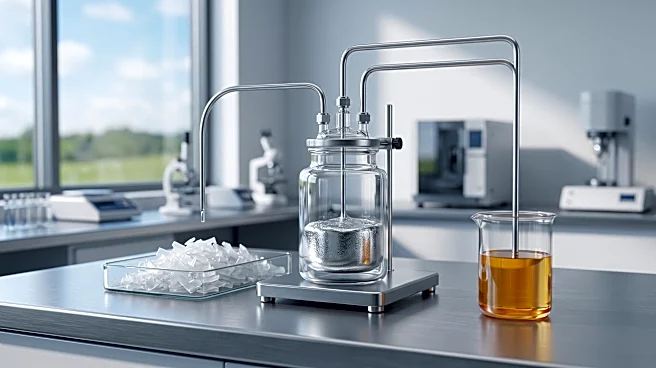
Scientists at the Department of Energy's Oak Ridge National Laboratory (ORNL) have created a novel method to transform polyethylene, a widely used plastic found in items like shopping bags and cutting boards, into gasoline and diesel-like fuels. This
process utilizes inexpensive aluminum-based molten salts, which act as both the reaction medium and the catalyst. These molten salts break down the long molecular chains of plastic into smaller hydrocarbons. The research, for which a patent has been applied, was published in the Journal of the American Chemical Society. The method achieves approximately 60% gasoline yield under relatively mild conditions, specifically at temperatures below 200 degrees Celsius. This is significantly lower than traditional pyrolysis methods, which typically require temperatures of 450 to 500 degrees Celsius. The ORNL team's approach also eliminates the need for noble-metal catalysts, organic solvents, or external hydrogen, simplifying the conversion process.
Why It's Important?
This scientific breakthrough holds significant implications for addressing both plastic waste management and U.S. energy security. The ability to efficiently convert abundant plastic waste into valuable fuels could reduce the environmental burden of plastic pollution, which is a growing global concern. Furthermore, by creating a domestic source of gasoline and diesel from waste materials, the U.S. could enhance its energy independence and reduce reliance on imported fossil fuels. The lower temperature requirements and the use of inexpensive catalysts make this process potentially more economically viable and scalable than previous methods. If successfully scaled, this technology could foster new industries and job creation in waste-to-energy sectors, contributing to industrial competitiveness and a circular economy.
What's Next?
The researchers at ORNL are currently focused on addressing the stability of the aluminum-based molten salts, which are hygroscopic and readily absorb water. Future work will investigate methods to confine these molten salts, possibly using halogens or carbon-based materials, to improve their stability and facilitate separation and processing. The goal is to make the technology more robust for industrial application. If these challenges are overcome, the next steps would involve scaling up the process beyond laboratory experiments to pilot and then commercial-scale facilities. This would require further investment and collaboration with industry partners to develop the necessary infrastructure and refine the technology for large-scale fuel production from plastic waste. The long-term vision is to expand the range of methods available for producing transportation and industrial fuels from waste materials.
Beyond the Headlines
Beyond the immediate benefits of waste reduction and fuel production, this research highlights a broader shift towards innovative solutions for resource management. The concept of transforming waste into valuable commodities challenges traditional linear economic models and promotes a more circular approach. Ethically, it addresses the responsibility of managing the vast quantities of plastic produced globally, offering a potential pathway to mitigate its long-term environmental impact. The scientific methodology, involving detailed tracking of chemical reactions using advanced analytical techniques like soft X-ray spectroscopy and neutron scattering, underscores the importance of fundamental research in driving technological advancements. This development could also inspire further research into converting other types of waste materials into useful products, fostering a more sustainable future.