





What's Happening?
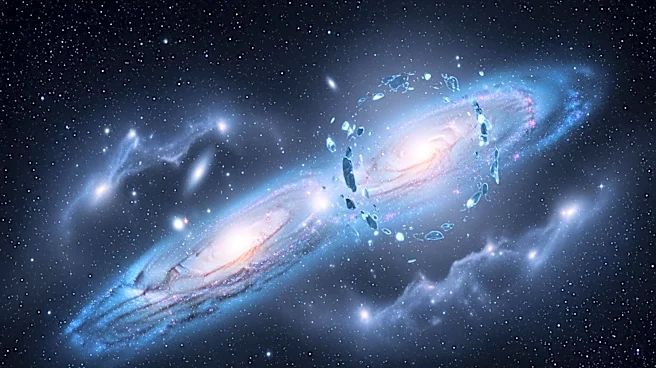
Astronomers have discovered a collection of 20 unusual metal-poor stars near the Milky Way's disk, which may be remnants of an ancient dwarf galaxy consumed by the Milky Way approximately 10 billion years ago. This ancient galaxy has been nicknamed 'Loki'
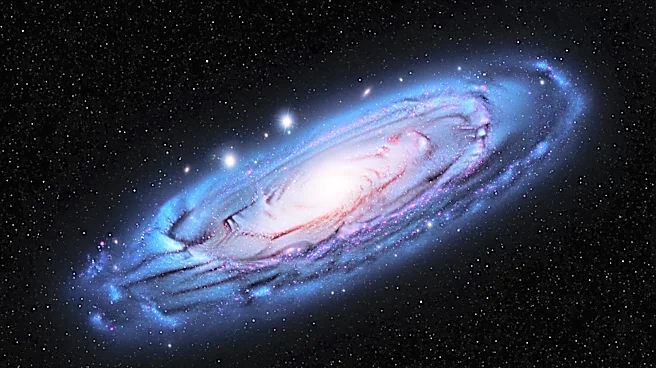
after the Norse god of mischief due to the initially puzzling orbital patterns of these stars. The discovery, published in the Monthly Notices of the Royal Astronomical Society, could provide significant insights into the Milky Way's formation history. The Milky Way, which spans about 100,000 light-years and contains between 100 billion and 400 billion stars, has grown over time by merging with multiple dwarf galaxies. The metal-poor stars, detected close to the galactic disk, suggest that the Milky Way's history includes significant mergers that have shaped its current structure.
Why It's Important?
This discovery is crucial for understanding the Milky Way's evolutionary history, as it highlights the galaxy's growth through the absorption of smaller galaxies. The identification of these metal-poor stars provides evidence of past galactic mergers, which are key to piecing together the Milky Way's formation. Such findings can alter the current understanding of how large galaxies like the Milky Way evolve over billions of years. The study also emphasizes the importance of using chemical compositions as fingerprints to trace the origins of stars, offering a method to uncover hidden aspects of galactic history. This research could lead to a reevaluation of the Milky Way's growth and the role of ancient mergers in shaping its structure.