



What's Happening?
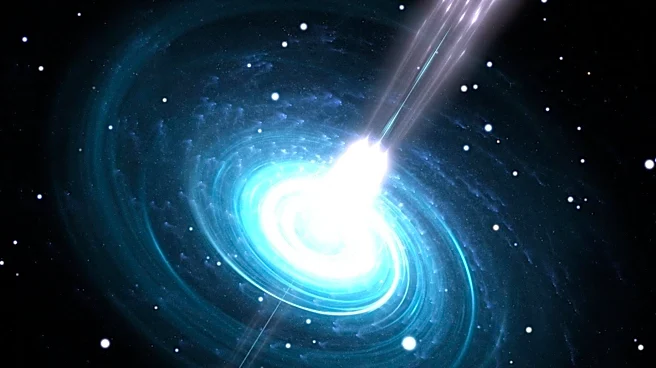
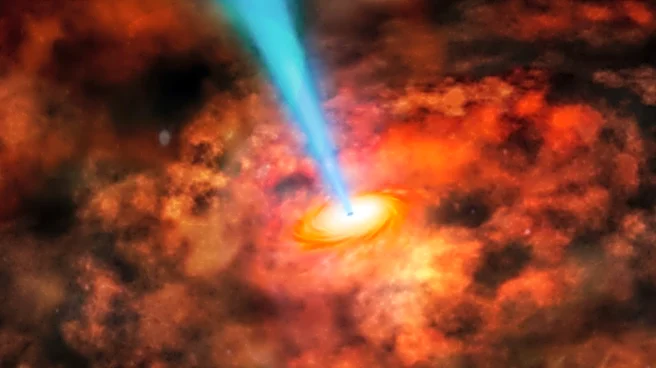
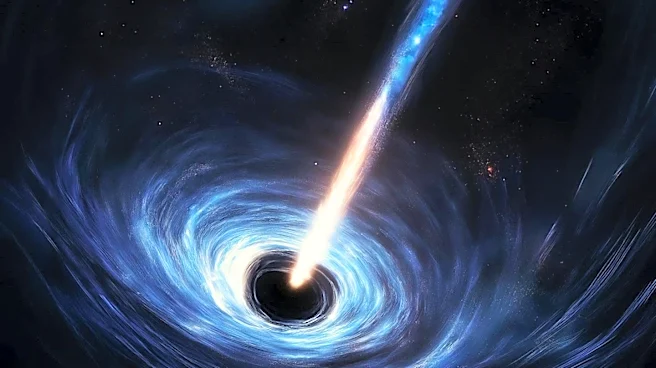
A recent study of 324 galaxies has provided observational evidence that powerful jets emanating from supermassive black holes can energize gas located far beyond their host galaxies. This gas, known as the circumgalactic medium (CGM), extends 10-20 times
farther than a galaxy and serves as a reservoir for star-forming material. While galaxies do not form stars at the rate expected if all this gas cooled and collapsed, the study, led by Namrata Roy, Assistant Professor in the Astronomy and Astrophysics Division at the Raman Research Institute, suggests that black-hole jets inject energy into the gas directly in their path. Researchers used data from the Dark Energy Spectroscopic Instrument (DESI) to detect a faint red glow from ionized hydrogen in the CGM, finding it to be about 100 times brighter in galaxies with such jets, particularly along the jet's direction. This indicates that the jets compress, heat, and ionize the surrounding gas in a narrow beam rather than spreading energy uniformly.
Why It's Important?
This research is significant because it offers a potential mechanism for how supermassive black holes might influence star formation across vast cosmic distances. By energizing the circumgalactic medium, black-hole jets could make it more difficult for cold gas to cool, clump, and efficiently form new stars. This finding provides observational support for a long-suspected theory that black holes play a role in regulating the star formation rates of galaxies. Understanding this interaction is crucial for refining cosmological models that describe galaxy evolution and the distribution of matter in the universe. The study highlights that the energy released by black holes can reach hundreds of thousands of light-years away, altering the state of gas that would otherwise contribute to stellar nurseries. This could explain why galaxies do not produce stars at their theoretical maximum rates, impacting our understanding of galactic life cycles.
What's Next?
The current study demonstrates that black-hole jets can alter the state of gas far from galaxies, but it does not yet definitively prove that these jets directly suppress star formation. Future research will focus on establishing this causal link. Researchers plan to conduct further observations and modeling to determine if galaxies more strongly affected by these jets indeed form fewer stars. This will involve studying the glowing gas in individual galaxies using advanced telescopes like Hubble. These observations will aim to measure the speed and energization levels of the gas, providing more detailed insights into the dynamics of the circumgalactic medium. Such follow-up studies are essential to fully understand the long-term implications of black-hole jet activity on galactic evolution and star birth rates.
Beyond the Headlines
The implications of this study extend beyond the immediate understanding of star formation. It deepens our comprehension of the intricate feedback loops between supermassive black holes and their host galaxies, suggesting a more profound and far-reaching influence than previously confirmed. The discovery that these jets act as narrow beams rather than diffuse energy sources also refines our models of energy transfer in the intergalactic medium. This could have broader implications for understanding the distribution of elements and the thermal history of the universe. Furthermore, if black holes actively regulate star formation, it suggests a fundamental control mechanism that shapes the cosmic landscape, influencing where and when stars and, consequently, planetary systems can form. This interplay highlights the interconnectedness of cosmic phenomena, from the smallest particles to the largest structures in the universe.