




What's Happening?
Astronomers have identified S301, the fastest-known star in the Milky Way, orbiting the supermassive black hole Sagittarius A* (Sgr A*) at the galactic center. S301 completes an orbit in just 8.7 years, a record for stars around Sgr A*, and reaches speeds
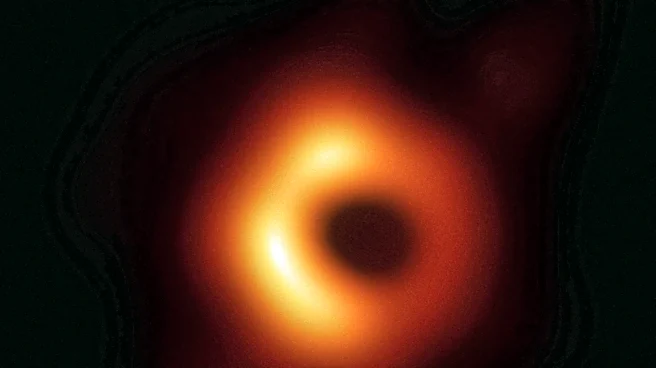
of approximately 25,000 km/s at its closest approach. This star's highly eccentric orbit brings it significantly closer to Sgr A* than previously studied stars like S2. The proximity of S301 to the black hole means its trajectory is strongly influenced by relativistic effects, including Schwarzschild precession and the more subtle Lense-Thirring precession. The latter, caused by Sgr A*'s spin dragging spacetime, forces S301's orbital plane to wobble. By precisely tracking this wobble, scientists aim to measure the spin of Sgr A*, a crucial characteristic of black holes that has been difficult to determine with high accuracy. The research team, including Felix Mang, a PhD student at Max Planck Institute for Extraterrestrial Physics (MPE), published their findings in Nature.
Why It's Important?
The discovery of S301 and the ability to precisely track its orbit represent a significant advancement in astrophysics and our understanding of black holes. Measuring the spin of Sgr A* is vital because a black hole is characterized solely by its mass, spin, and electric charge. While Sgr A*'s mass has been determined with sub-percent precision, its spin remains largely unknown. The Lense-Thirring effect, which S301's orbit can probe, is a direct consequence of Einstein's general theory of relativity and provides a unique opportunity to test this fundamental theory in extreme gravitational environments. Accurate measurements of black hole spin can shed light on the formation and evolution of galaxies, as supermassive black holes are believed to play a critical role in these processes. This research could also refine models of spacetime dynamics and gravitational physics, impacting our broader cosmological understanding.
What's Next?
Astronomers anticipate that upcoming technological advancements will significantly enhance their ability to track S301's motion and, consequently, measure Sgr A*'s spin. The GRAVITY instrument, used for current observations, is undergoing major upgrades expected to provide more flux and better astrometric precision. Furthermore, the Extremely Large Telescope (ELT) and its first-light instrument, MICADO, are projected to be operational by approximately 2030. These advanced instruments will allow for unprecedented precision in tracing S301's trajectory. Researchers are confident that combining astrometry from GRAVITY with velocity measurements from MICADO will enable them to decode the mystery of Sgr A*'s spin within the next decade. This will involve analyzing how the star's trajectory is shifted by both Schwarzschild and Lense-Thirring precession effects to isolate the spin-induced component.
Beyond the Headlines
The precise measurement of Sgr A*'s spin through the observation of S301 has profound implications beyond just understanding a single black hole. It offers a unique laboratory for testing the limits of Einstein's general theory of relativity under extreme conditions, potentially revealing new physics if observations deviate from theoretical predictions. The Lense-Thirring effect, a subtle yet powerful manifestation of spacetime curvature, could be directly quantified, providing empirical evidence for frame dragging. This research also highlights the ongoing evolution of observational astronomy, where increasingly sophisticated instruments and analytical techniques allow scientists to probe previously inaccessible phenomena. The insights gained from Sgr A*'s spin could inform our understanding of other supermassive black holes across the universe, influencing theories of galaxy formation, active galactic nuclei, and the fundamental nature of gravity itself. It underscores the interconnectedness of cosmic phenomena and the continuous quest to unravel the universe's deepest secrets.