






What's Happening?
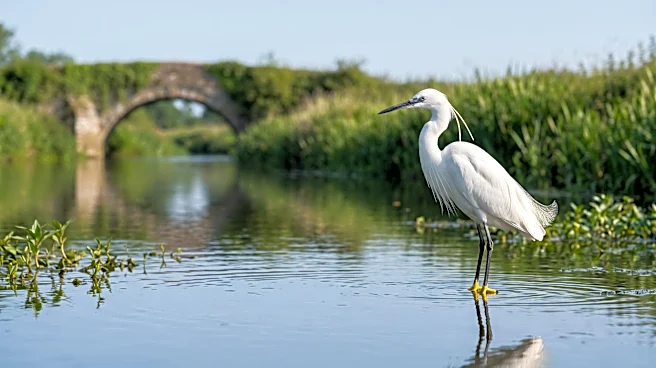
A little egret, a small white heron, was recently photographed by Karen Lynch at Victoria Bridge, Hereford, in the UK. This sighting highlights the increasing presence of the species in the region. Historically, the little egret was a rare visitor to the UK,
primarily found in Mediterranean areas. However, its numbers have grown significantly, particularly in southern England and Wales. The bird's expanded habitat is largely attributed to climate change, which has led to rising temperatures and more favorable conditions for the species in the UK. The little egret first bred in the UK on Brownsea Island, Dorset, in 1996, and was recorded breeding in Berkshire for the first time in 2007. These birds are identifiable by their black legs, yellow feet, black bill, and, during breeding season, long plumes on their head and neck. While still less common in Scotland and inland areas, their continued sightings in places like Hereford indicate a broader territorial shift.
Why It's Important?
The increasing presence of the little egret in the UK serves as a tangible indicator of the ecological impacts of climate change. The expansion of this species' habitat northward from the Mediterranean region directly correlates with rising global temperatures. This phenomenon underscores how climate shifts are altering biodiversity and species distribution, potentially leading to new ecological balances or imbalances. For the UK, the little egret's establishment signifies a change in its native avifauna, which could have broader implications for local ecosystems, including competition with native species for resources or changes in predator-prey dynamics. The historical context of the egret's near extinction in the 19th century due to the demand for its plumes, followed by its recovery and current expansion, also highlights the complex interplay between human activity, conservation efforts, and environmental changes. This event provides a clear, observable example of how climate change is already affecting natural environments.
What's Next?
Continued monitoring of the little egret's population and distribution in the UK will be crucial to understand the long-term ecological consequences of its expanding habitat. Scientists and conservationists will likely track its breeding success, migratory patterns, and interactions with other bird species. Further research may focus on how the changing climate will continue to influence the egret's range and whether this trend will extend to other species. Policy discussions around climate change mitigation and adaptation may draw upon such observable ecological shifts as evidence of ongoing environmental transformation. Local communities and wildlife organizations may also need to adapt their conservation strategies to accommodate new species or changes in existing populations. The ongoing presence of the little egret in new areas could also lead to increased public awareness and engagement with climate change issues, as people observe these changes in their local environments.
Beyond the Headlines
Beyond the immediate ecological implications, the little egret's story touches upon broader themes of environmental resilience and the interconnectedness of global ecosystems. The bird's historical decline due to human exploitation for its plumes, followed by its recovery and current expansion driven by climate change, illustrates the dual impact of human actions on the natural world. It highlights how past conservation successes can be intertwined with new environmental challenges. The egret's journey from a rare visitor to a more common sight in the UK also symbolizes a shift in the perceived 'natural' state of local environments, prompting questions about what constitutes native versus introduced species in a rapidly changing climate. This ongoing ecological transformation could influence cultural perceptions of wildlife and nature, potentially fostering a greater appreciation for adaptability in the face of environmental flux, while also serving as a stark reminder of the pervasive reach of climate change.