






What's Happening?
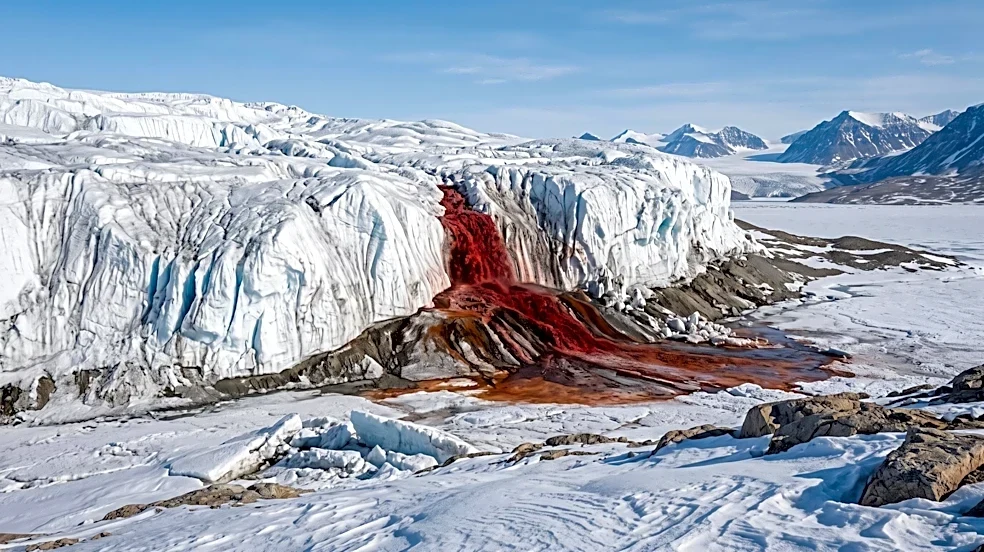
Blood Falls, a five-story waterfall in Antarctica, flows from Taylor Glacier and is characterized by its red color. This coloration occurs when iron-rich, salty water from a subglacial lake interacts with oxygen in the air, causing a reaction similar
to rust formation. Scientists believe the lake beneath the glacier was filled by ocean water approximately 5 million years ago and has been isolated from other water sources for at least a million years. Over time, the water became significantly saltier, now being more than twice as saline as the ocean, which prevents it from freezing. This isolated, anoxic environment has allowed microbes to thrive for millions of years without light or oxygen, utilizing sulfates for energy, a process akin to microbes found in deep-sea thermal vents.
Why It's Important?
The unique ecosystem of Blood Falls offers a rare glimpse into how life can adapt and survive in extreme conditions, providing critical insights for astrobiology. The microbes' ability to extract oxygen from sulfates and regenerate sulfates through interaction with iron suggests a self-sustaining energy source, which has profound implications for understanding the potential for life on other planets. Scientists hypothesize that similar salty underground lakes could exist on celestial bodies like Mars and Jupiter's icy moons. Studying these extremophiles helps researchers develop models for detecting and understanding extraterrestrial life, influencing future space exploration missions and the search for biosignatures beyond Earth. This research also expands our understanding of Earth's own biodiversity and the limits of life.
What's Next?
Future research at Blood Falls will likely focus on further characterizing the microbial communities and their metabolic pathways to understand their long-term survival mechanisms. Scientists will continue to analyze the chemical composition of the subglacial lake to better comprehend the energy cycles that sustain these organisms. This ongoing study could lead to the development of new technologies for detecting life in extreme environments, both on Earth and in space. Additionally, the findings may inform strategies for planetary protection, ensuring that human exploration does not contaminate potential extraterrestrial life forms. Collaborative efforts among astrobiologists, geologists, and microbiologists are expected to deepen our understanding of this unique Antarctic phenomenon.
Beyond the Headlines
The discovery and study of Blood Falls challenge conventional notions of habitability, demonstrating that life can persist and evolve in environments previously thought to be inhospitable. This pushes the boundaries of what defines a 'livable' planet, suggesting that subsurface oceans and isolated water bodies on other worlds could harbor life. The concept of a 'biological time capsule' also highlights the importance of preserving such unique geological formations, as they hold ancient biological and environmental data. Ethically, the study of these extremophiles raises questions about the definition of life and its resilience, prompting a re-evaluation of our anthropocentric views on biological existence. The implications extend to philosophical discussions about the prevalence of life in the universe and humanity's place within it.