




What's Happening?
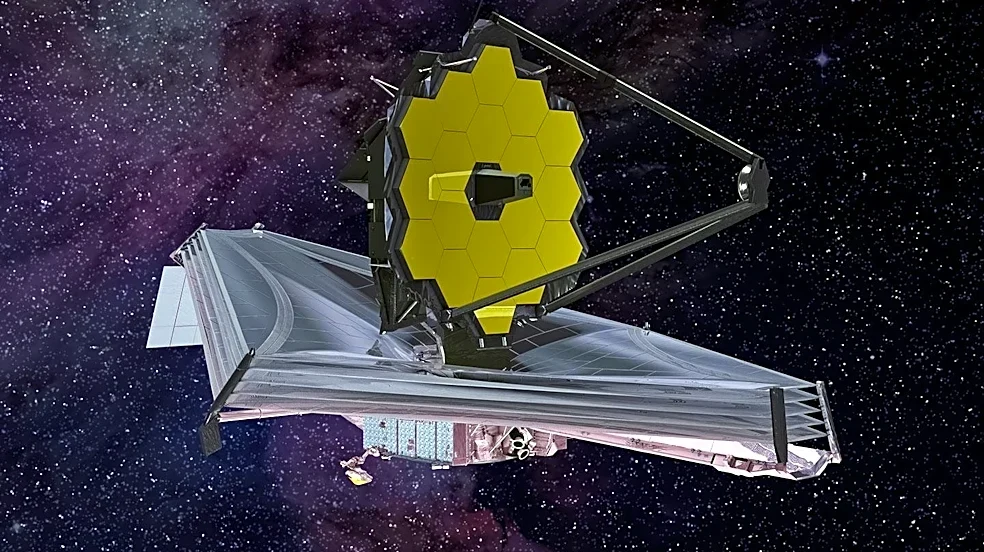
Recent observations using the James Webb Space Telescope (JWST) have provided detailed insights into the atmosphere of WISE 0855, the coldest known brown dwarf. Researchers have discovered that this substellar object, with a temperature of approximately
265 Kelvin, exhibits patchy water clouds and significant chemical variations in its atmosphere. The study, as reported by StellarCatalog.com, utilized time-series data collected over an 11-hour period to analyze infrared light. This analysis allowed scientists to differentiate between the effects of temperature, chemical composition, and cloud structure, revealing dynamic weather patterns on an object that bridges the gap between giant planets and stars.
Why It's Important?
This research is crucial for understanding atmospheric processes on substellar objects and exoplanets. WISE 0855, being the coldest brown dwarf, serves as a natural laboratory for studying extreme atmospheric conditions that are difficult to observe on exoplanets orbiting distant stars. The findings indicate that the concentration of gases like carbon monoxide and phosphine fluctuates over time, linked to deep atmospheric pressures, while water cloud thickness varies at higher, lower-pressure regions. This detailed understanding of cloud formation and chemical changes on brown dwarfs can inform models for gas giant exoplanets, improving our ability to characterize their atmospheres and potentially identify conditions for habitability in other solar systems.
What's Next?
The detailed observations of WISE 0855 will likely lead to more refined atmospheric models for brown dwarfs and gas giant exoplanets. Scientists will continue to analyze the data to further understand the interplay between temperature, chemistry, and cloud dynamics. The techniques developed for this study, particularly the use of time-series data and infrared analysis, can be applied to other brown dwarfs and exoplanets to uncover similar atmospheric complexities. This will contribute to a broader understanding of the diverse range of weather systems and atmospheric compositions present in the universe, pushing the boundaries of exoplanetary science.
Beyond the Headlines
The study of WISE 0855 goes beyond simply identifying clouds; it delves into the intricate chemical and physical processes that govern the atmospheres of objects outside our solar system. The discovery of fluctuating gas concentrations and varying cloud layers highlights the dynamic and complex nature of these distant worlds, suggesting that even seemingly inert objects can host vibrant atmospheric activity. This research contributes to the larger narrative of understanding planetary diversity and the conditions under which different types of celestial bodies evolve. It also underscores the power of advanced observational tools like the James Webb Space Telescope in revealing previously unseen details of our cosmic neighborhood.