




What's Happening?
Researchers at The University of Texas at San Antonio have developed a self-sustaining, artificial intelligence-powered flood warning system designed to detect dangerous water accumulation at street level. Led by Dr. Chen Pan, assistant professor of electrical
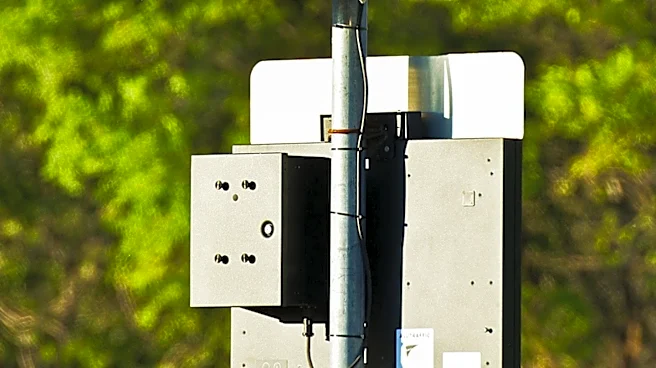
engineering, the team engineered a field-ready prototype that integrates solar energy harvesting, multi-sensor environmental tracking, long-range wireless radios, and on-device machine learning. This system is designed to operate off-grid, generating its own power and evaluating flood risk locally without relying on external electricity or network lines. The prototype combines temperature, humidity, light, and precipitation sensing with four optical water-level sensors, achieving greater reliability through multi-modal sensing. The system utilizes TinyML to run machine learning algorithms directly on small, low-power microcontrollers, ensuring warnings are sent even if cell towers or internet connections fail during a storm.
Why It's Important?
This innovative flood warning system holds significant importance for communities, particularly in regions prone to sudden and localized flooding like Texas. Traditional flood monitoring systems often fall short in detecting hyper-local flash floods and can be vulnerable to power outages or network failures during severe weather. Dr. Pan's self-powered, AI-driven system addresses these critical limitations by providing timely and accurate warnings at the street level, even in remote or infrastructure-compromised areas. This capability can save lives, prevent property damage, and enable emergency responders to make more informed decisions, such as dispatching crews or closing dangerous roads, long before floodwaters peak. The affordability of the prototype, with parts costing between $150 and $220, makes it a viable solution for small coastal municipalities, homeowners' associations, and agricultural operations, democratizing access to advanced flood detection technology.
What's Next?
Dr. Pan is currently pursuing patent protection for the hardware architecture of the flood warning system. The team's next step is to refine the design into a sleeker, weatherized commercial product suitable for widespread deployment. The goal is to make this technology accessible to various entities, including small coastal municipalities, homeowners' associations, agricultural operations, and industrial sites. Further research and development may focus on expanding the system's capabilities, integrating it with existing emergency response infrastructures, and exploring partnerships for mass production and distribution. The success of this prototype could lead to its adoption in other flood-prone regions across the U.S., significantly enhancing disaster preparedness and community resilience against the impacts of climate change and extreme weather events.
Beyond the Headlines
The development of this self-powered flood warning system represents a broader trend in leveraging artificial intelligence and sustainable energy solutions for environmental monitoring and disaster preparedness. It highlights the potential of localized, intelligent systems to address specific challenges that large-scale infrastructure might miss. Ethically, providing affordable and reliable flood warnings to vulnerable communities, especially those in rural or underserved areas, can significantly reduce inequalities in disaster preparedness. This technology also underscores the importance of interdisciplinary research, combining electrical engineering, computer science, and environmental science to create practical solutions. The long-term implications include fostering more resilient communities, reducing economic losses from natural disasters, and potentially influencing public policy towards decentralized and intelligent environmental monitoring systems, ultimately contributing to a more sustainable and safer future.