



What's Happening?
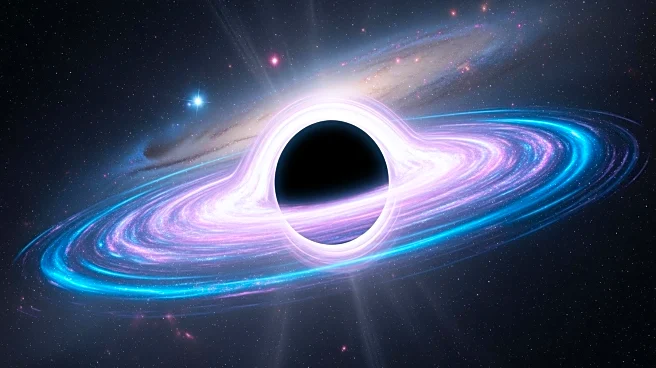
On February 13, 1974, astronomers made a groundbreaking observation of the black hole at the center of the Milky Way, known as Sagittarius A* (Sgr A*). This discovery was facilitated by the National Radio Astronomy Observatory (NRAO) in Green Bank, West
Virginia, using long-baseline interferometry. Astronomers Bruce Balick and Robert Brown detected an intense radio signal from the galactic center, marking the first time such a phenomenon was observed. Their findings were published in the Astrophysical Journal later that year, laying the groundwork for future research into the nature of black holes.
Why It's Important?
The observation of Sgr A* was a pivotal moment in astronomy, providing the first direct evidence of a supermassive black hole at the center of our galaxy. This discovery has profound implications for our understanding of galactic dynamics and the role of black holes in the universe. It opened new avenues for research into the behavior of matter under extreme gravitational forces and has since been a cornerstone in the study of astrophysics. The ability to observe such distant and powerful phenomena has also driven technological advancements in telescope design and observational techniques.
Beyond the Headlines
The discovery of Sgr A* has not only advanced scientific knowledge but also sparked public interest in astronomy and the mysteries of the universe. It highlights the importance of international collaboration in scientific research, as the initial proposal for the observation came from astronomers working in Germany. The ongoing study of Sgr A* continues to challenge and refine our understanding of fundamental physics, including the nature of gravity and the behavior of light near massive objects.