
What's Happening?
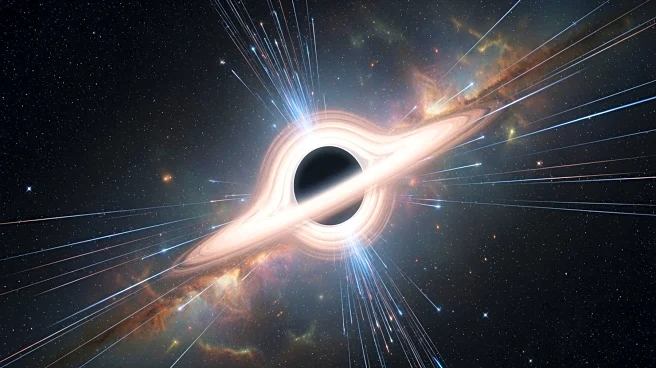
Astronomers have observed a supermassive black hole at the center of the galaxy NGC 3783 ejecting matter at speeds of 60,000 km/sec, the highest ever recorded. This discovery was made using the European Space Agency's XMM-Newton and the X-Ray Imaging
and Spectroscopy Mission (XRISM), a collaboration involving JAXA, ESA, and NASA. The research, led by Liyi Gu from the Space Research Organization Netherlands, revealed that a rapid burst of X-ray light from the black hole triggered ultra-fast winds, forming in just a single day. The black hole, with a mass equivalent to 30 million suns, exhibited winds similar to solar eruptions, albeit on a much larger scale.
Why It's Important?
This observation provides new insights into the behavior of supermassive black holes, which are among the most mysterious and energetic objects in the universe. Understanding the mechanisms behind such high-speed ejections can help scientists learn more about the dynamics of black holes and their impact on their surrounding environments. The study also draws parallels between black hole activity and solar phenomena, suggesting that these cosmic giants may not be as alien as previously thought. This research could have implications for our understanding of galaxy formation and evolution, as well as the role of black holes in the universe.