


What's Happening?
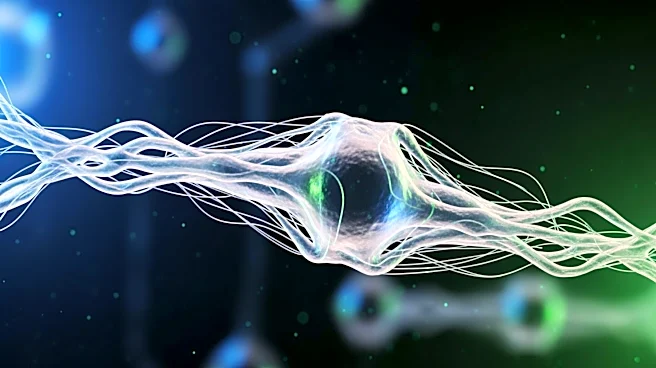
Researchers at Tufts University, led by biologist Michael Levin, have developed 'neurobots,' which are living robots composed of biological cells that include neurons forming functional circuits. These neurobots represent a significant advancement in bioengineering,
as they are capable of self-directed movement and can potentially be used in applications such as precision tissue repair and environmental cleanup. The neurobots are built from frog cells and are designed to mimic simple neural networks, providing insights into complex behaviors. This development is part of a broader effort to integrate biological tissue with engineered control systems, moving beyond traditional mechanical robotics.
Why It's Important?
The creation of neurobots marks a pivotal step in the field of bioengineering, offering new possibilities for integrating biological and mechanical systems. This technology could revolutionize areas such as medical treatment and environmental monitoring by providing more precise and adaptable solutions. The ability of neurobots to self-organize and perform complex tasks could lead to significant advancements in understanding neural networks and developing cyborg systems. This innovation also raises important questions about the nature of biological organization and the potential for engineered biological systems to perform tasks traditionally handled by machines.
What's Next?
Future developments in neurobot technology may include the integration of human neural cells, expanding their potential applications. Researchers aim to refine these living machines to perform specific tasks, similar to how animals are trained for certain functions. The commercial startup Fauna Systems, co-founded by Levin, is exploring environmental sensing applications for these technologies. As the technology matures, it could lead to more sophisticated systems capable of complex environmental monitoring and other applications, although technical challenges remain.
Beyond the Headlines
The development of neurobots also prompts ethical and philosophical considerations about the creation and use of living machines. Questions about the origins of form and function in biological systems, especially those not evolved or traditionally engineered, are central to this research. The potential for neurobots to perform tasks autonomously raises discussions about the future role of biological machines in society and their impact on existing technologies and industries.