






What's Happening?
An international team of paleontologists has formally described a new species of feathered, plant-eating theropod, Kayrasaurus changliensis, from China's Jehol Biota. This discovery, detailed in the Journal of Systematic Palaeontology, challenges previous
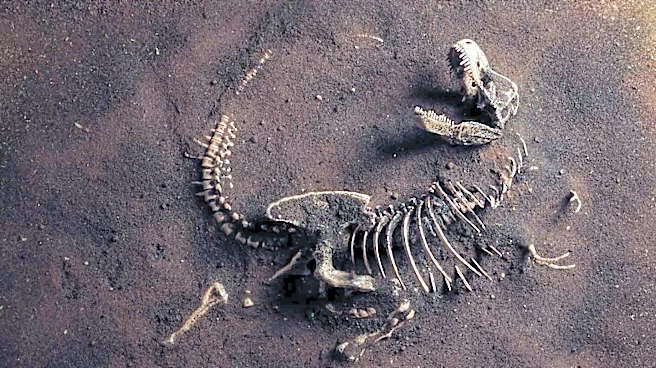
assumptions about how therizinosaurs coexisted. Kayrasaurus changliensis is the largest and most anatomically unusual therizinosaur found in this fossil bed, measuring over 3.6 meters (11.8 feet) long and estimated to weigh between 117 and 274 kilograms. The specimen, a subadult, suggests fully grown adults could have been even larger. Key distinguishing features include a lower jaw with over 45 tooth positions, the highest recorded for any therizinosaur, and a unique sub-triangular external mandibular fenestra. Its elongated neck architecture indicates it could reach higher vegetation, differentiating its feeding strategy from other therizinosaurs in the same ecosystem.
Why It's Important?
The discovery of Kayrasaurus changliensis is significant because it provides crucial insights into the ecological dynamics of ancient ecosystems. Previously, it was assumed that the rarity of therizinosaurs in the fossil record indicated they were ecological generalists occupying narrow niches. However, finding four distinct therizinosaur species in the same formation, with evidence of differing body plans and likely diets, suggests niche partitioning. This ecological process allows competing species to reduce direct competition by specializing in different resource spaces. The study's ecomorphological analysis indicates at least two distinct ecological strategies among Jehol therizinosaurs: one favoring robust builds and high browsing (like Kayrasaurus and Beipiaosaurus) and another emphasizing agility and lower-level foraging (like Jianchangosaurus and Lingyuanosaurus). This understanding refines our knowledge of dinosaur evolution and how diverse species coexisted within a shared environment.
What's Next?
The ecological interpretations derived from the Kayrasaurus changliensis discovery are currently provisional. Future fieldwork in the Yixian Formation is anticipated to uncover additional Kayrasaurus material, particularly hindlimb elements and more complete fossils of existing Jehol therizinosaurs. Such discoveries would allow for more rigorous testing of the proposed niche partitioning hypothesis and provide a definitive body mass estimate from femoral circumference, which is currently limited by the incomplete specimen. Continued biomechanical analyses and new fossil discoveries are essential to further illuminate the evolutionary pathways and paleoecological diversity of this enigmatic group of dinosaurs. The specimen (IVPP V 18597) is permanently housed at the IVPP in Beijing and a 3D digital model of the skull and left mandible is publicly accessible for further study.
Beyond the Headlines
The Kayrasaurus changliensis discovery highlights the ongoing evolution of paleontological understanding, demonstrating that even well-studied fossil beds can yield surprises that overturn long-held assumptions. The shift of therizinosaurs from carnivorous ancestors to specialized herbivores, as established by Dr. Lindsay Zanno's 2009 study, is a remarkable example of evolutionary adaptation. This new species further complicates and enriches that narrative by showing how different herbivorous strategies could emerge within the same lineage and ecosystem. The meticulous analysis of anatomical features, even from severely compressed fossils, underscores the power of modern paleontological techniques, such as CT scanning, to reveal intricate details about extinct life forms. This research not only expands our knowledge of dinosaur diversity but also provides a compelling case study for ecological principles like niche partitioning in deep time.