




What's Happening?
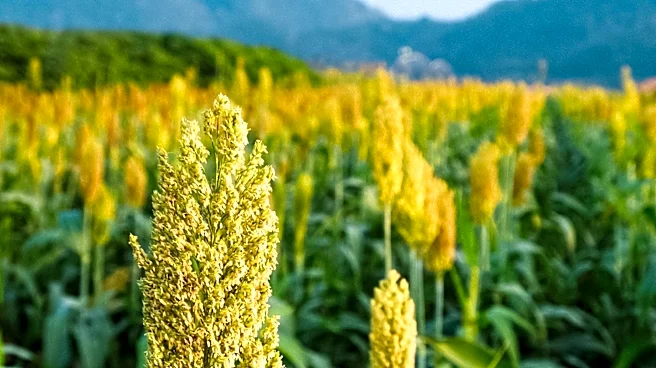
A recent study published in the journal Earth’s Future suggests that sorghum, a heat and drought-tolerant crop, could play a crucial role in helping Europe adapt to increasingly hotter and drier summers. Currently, sorghum accounts for only 0.1% of Europe's
cropland, primarily used for animal feed. However, researchers, led by Mohsen Davoudkhani from the Université Paris-Saclay, along with colleagues from INRAE and CNRS, have developed a machine learning model to assess sorghum's potential. This model, trained on 11,644 yield records from France, Italy, Spain, and the United States between 2000 and 2020, projects that average sorghum yields across Europe could rise from 3 tons per hectare to between 3.4 and 3.8 tons by the end of the century. The study highlights sorghum's ability to thrive in conditions where traditional crops like maize struggle, offering a viable alternative for European agriculture facing climate change.
Why It's Important?
The findings are significant for European agriculture, which has seen maize yields hit relative all-time lows due to hotter and drier summers. Sorghum's resilience to high temperatures and low water availability presents a strategic advantage, potentially reducing Europe's reliance on water-intensive crops like maize. This shift could lead to substantial water savings, as approximately 38% of irrigated cropland in France is dedicated to maize, compared to just 5% for sorghum. Furthermore, sorghum requires less fertilizer and pesticides than maize, offering environmental benefits such as reduced nitrate pollution and lower fertilizer emissions. While the study focuses on Europe, the implications for global food security and agricultural adaptation to climate change are considerable, demonstrating how overlooked crops can provide solutions to widespread environmental challenges.
What's Next?
The study advocates for localized agricultural planning rather than a one-size-fits-all approach, given the projected regional variations in sorghum yields across Europe. While northern European regions like Germany, Poland, and Lithuania could see significant yield increases, southern areas such as central Spain, southern France, and Italy might experience declines. The research suggests that if farmers incorporate sorghum into their crop rotations one year out of three, sorghum harvests could meet at least 90% of the maize currently used for livestock feed. However, the authors caution that successful integration depends on breeders developing varieties suited for Europe, establishing robust markets, and farmers adopting new management practices. Further research is needed to account for factors like soil conditions, farming practices, and the effects of rising carbon dioxide, which were not included in the current model.
Beyond the Headlines
Beyond its immediate agricultural benefits, the increased adoption of sorghum could trigger broader shifts in European land use and resource management. The potential for significant water and fertilizer savings could alleviate pressure on natural resources and contribute to more sustainable farming practices. This move towards climate-resilient crops also underscores a growing recognition of the need for agricultural diversification to mitigate the risks associated with climate change. The study highlights the ethical imperative to explore and invest in crops that can ensure food security in a changing climate, moving away from monoculture reliance. It also points to the critical role of machine learning and data analysis in predicting agricultural trends and informing policy decisions for future food systems.