




What's Happening?
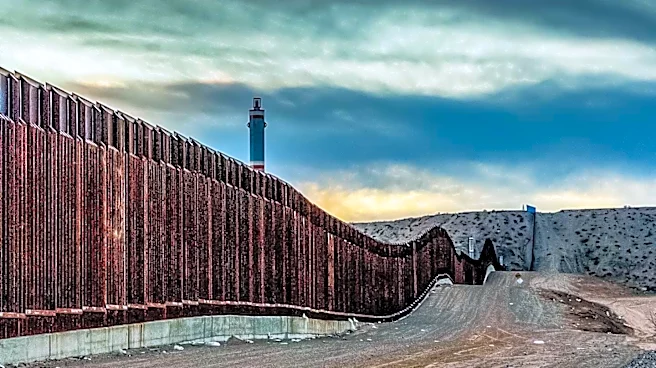
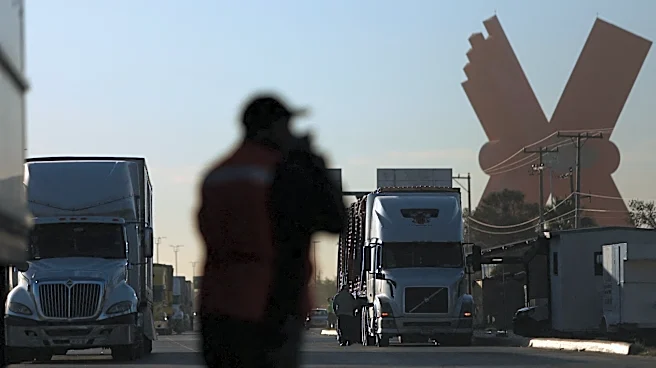
President Trump is re-emphasizing his commitment to building a wall along the U.S.-Mexico border, a central promise from his 2016 campaign. Despite a significant decrease in irregular border crossings, with numbers at historic lows since 1970, the administration
has allocated nearly $47 billion for new barriers. This funding, secured through the 2025 fiscal law, is intended to construct approximately 2,000 kilometers of new barriers by September 2029. The current approach involves an 'intelligent' wall system, incorporating nine-meter posts, parallel fences, roads, cameras, sensors, and artificial intelligence towers, along with floating cylinders in the Rio Grande. The administration has also suspended environmental, heritage, and contracting regulations under a 2005 law to expedite construction, leading to a surge in contract awards, with $19.4 billion in the first six months of the year. Two construction companies linked to Republican donors have received $12.3 billion of these contracts, raising concerns about competitive bidding.
Why It's Important?
The renewed focus on the border wall by President Trump carries significant implications for U.S. immigration policy, national security, and environmental protection. The substantial financial commitment of nearly $47 billion diverts considerable resources that could otherwise be allocated to other domestic priorities or alternative border management strategies. The suspension of environmental and heritage regulations to accelerate construction raises concerns among conservationists and indigenous groups, potentially leading to irreversible damage to natural landscapes and sacred sites, as evidenced by the damage to the Las Playas geoglyph in Arizona. Furthermore, the concentration of contracts with companies linked to Republican donors sparks questions about transparency and fairness in government procurement, potentially fostering an environment of cronyism. While the administration argues the wall enhances border security, critics contend that its effectiveness is debatable, especially given the current low rates of irregular crossings and the evolving methods of illegal entry. This initiative also serves as a potent political symbol, mobilizing President Trump's base and framing immigration as a primary national concern, even as national polls indicate economic issues are a greater concern for voters.
What's Next?
The administration plans to complete the primary border wall by the end of 2027, aiming to make the project financially and contractually entrenched to deter future Democratic administrations from halting it. Construction will continue, likely facing ongoing legal challenges from environmental groups and indigenous organizations seeking to protect affected lands and cultural sites. The controversy surrounding contract awards may lead to further scrutiny and potential investigations into the bidding process. Politically, the border wall will remain a prominent issue in the lead-up to the 2026 midterm elections, serving as a rallying point for President Trump's supporters and a point of contention for his opponents. The effectiveness of the 'intelligent' wall system will be closely monitored, with debates continuing over its actual impact on border security versus its environmental and financial costs. The long-term implications for U.S.-Mexico relations and regional stability will also be a key area of observation.
Beyond the Headlines
Beyond the immediate political and logistical aspects, President Trump's revival of the border wall promise highlights a deeper ideological struggle within the U.S. regarding national identity, sovereignty, and the approach to immigration. The wall, as a physical barrier, symbolizes a desire for clear, impermeable boundaries, reflecting a protectionist and nationalist sentiment. This contrasts with perspectives that advocate for more integrated, humanitarian, and economically collaborative approaches to border management. The use of advanced technology like AI in the 'intelligent' wall also raises ethical questions about surveillance, data privacy, and the potential for mission creep in border enforcement. The project's impact on cross-border communities, both human and ecological, underscores the complex interplay between policy decisions and their real-world consequences. The narrative surrounding the wall also serves as a powerful tool in political campaigning, simplifying complex issues into easily digestible slogans and images, which can polarize the electorate and shape the national discourse on immigration for years to come.