



What's Happening?
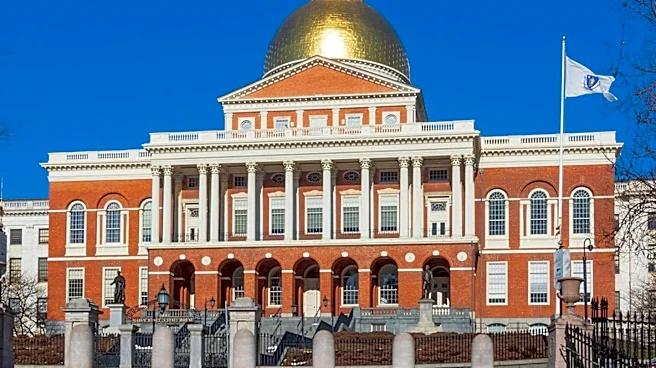
The Massachusetts Governor's Council unanimously approved two pardon recommendations from Governor Maura Healey during a brief meeting on Wednesday. The pardons were granted to Jayaar Gonzalez, convicted of selling cocaine in 1997 at age 17, and Brittany
Reichmann, convicted of two counts of possession with intent to distribute a Class A substance in 2014 at age 23. Gonzalez, who served 11 months of a one-to-two-year sentence, has since earned a GED and an HVAC license and plans to start a business. Reichmann, who developed a substance use dependency, completed her sentence in 2018 and has been sober since 2017, working in recovery and founding a small business. Both individuals sought pardons to remove barriers to employment and participation in community activities. Governor Healey has recommended 29 pardons since taking office in 2023.
Why It's Important?
The unanimous approval of these pardons by the Governor's Council underscores a commitment to restorative justice and second chances within the Massachusetts legal system. For individuals like Gonzalez and Reichmann, a pardon can be transformative, removing significant obstacles to employment, housing, and full civic participation that often persist long after a sentence is served. This action reflects a policy perspective that recognizes personal growth and rehabilitation, aiming to integrate individuals back into society rather than perpetually penalizing past mistakes. The pardons highlight the potential for the justice system to acknowledge when individuals have taken responsibility and made meaningful changes, thereby fostering economic opportunity and social reintegration. This approach can reduce recidivism and strengthen communities by allowing individuals to contribute fully to the workforce and society.
What's Next?
Following the Governor's Council's approval, the pardons for Jayaar Gonzalez and Brittany Reichmann will be formally issued, officially clearing their records of the specified convictions. This will enable them to pursue employment opportunities and engage in community activities without the limitations imposed by their past criminal records. Governor Healey is expected to continue reviewing and recommending additional pardons, as she has already recommended 29 since taking office. The Governor's Council will continue its role in reviewing these recommendations and judicial nominations. This ongoing process suggests a sustained focus on clemency as a tool for justice reform in Massachusetts, potentially leading to more individuals receiving second chances and contributing to the state's economy and social fabric.
Beyond the Headlines
The practice of granting pardons, as demonstrated by Governor Healey and the Governor's Council, touches upon deeper societal questions about forgiveness, redemption, and the purpose of the justice system. While punishment and deterrence are key components, the emphasis on rehabilitation and reintegration through pardons reflects a progressive view that individuals can change and deserve opportunities to rebuild their lives. This approach can help address systemic issues that disproportionately affect certain communities, such as the long-term economic and social consequences of criminal records. It also prompts a re-evaluation of how society views and treats individuals with past convictions, moving towards a more inclusive framework that values human potential over past errors. The ethical implications involve balancing public safety with individual rights and the belief in the capacity for personal transformation.