









What's Happening?
An op-ed published on Mining.com discusses China's strategic use of oversupply in critical minerals as a geopolitical tool. The article, authored by economic geologist Dr. Nicholas Vafeas, argues that China's regulatory announcements regarding export
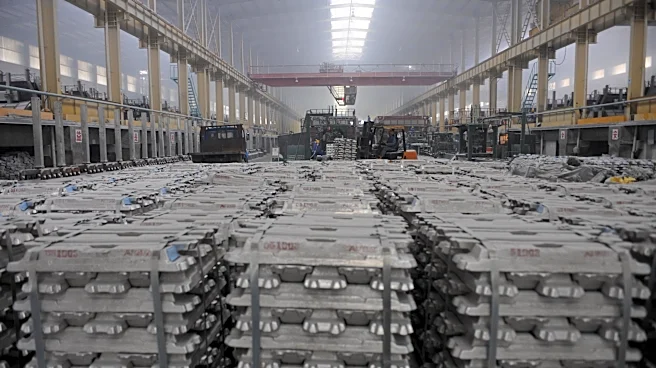
restrictions are a decoy. Instead, the real threat lies in China's ability to maintain low prices through aggressive oversupply. This strategy affects minerals such as lithium, cobalt, and nickel, whose prices have significantly dropped. The op-ed highlights that China's expansion of processing capacity and support for domestic and overseas projects have created a market environment where Western refiners struggle to compete. The article criticizes the Western response of stockpiling and subsidies, suggesting that these actions fail to address the core issue of China's economic leverage.
Why It's Important?
The implications of China's oversupply strategy are significant for Western industries, particularly in the critical minerals sector. By maintaining low prices, China undermines the financial viability of Western refining projects, which are crucial for reducing dependency on Chinese supply chains. This situation poses a risk to the development of a self-sufficient critical minerals industry in the West. The op-ed suggests that without strategic interventions, such as long-term offtake guarantees and price floors, Western projects may become financially unviable, leading to stranded assets. This could hinder efforts to build a resilient supply chain for critical minerals, which are essential for various industries, including technology and renewable energy.
What's Next?
The op-ed recommends that Western governments shift their focus from reacting to China's regulatory announcements to addressing the economic leverage China holds through its pricing strategy. This involves creating regulatory frameworks that protect Western refiners from predatory pricing and valuing processing capacity as a strategic asset. By implementing these measures, Western countries can build a more robust critical minerals supply chain, reducing their vulnerability to China's market influence. The article emphasizes the need for a coordinated approach among Western allies to ensure long-term security in critical minerals supply.
Beyond the Headlines
The deeper implications of China's strategy highlight the challenges of global economic competition and the need for strategic policy responses. The op-ed underscores the importance of understanding the integrated nature of critical minerals supply chains and the limitations of traditional economic responses. It calls for a reevaluation of how Western countries approach resource security, emphasizing the need for innovative solutions that go beyond conventional market mechanisms. This situation also raises questions about the role of state-backed enterprises in global markets and the ethical considerations of leveraging economic power in geopolitical strategies.