






What's Happening?
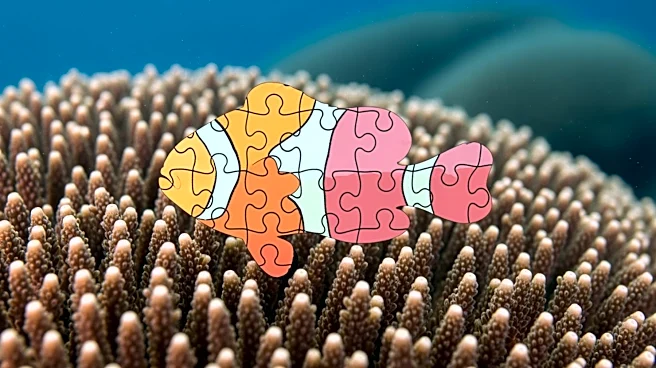
A team of researchers from the Okinawa Institute of Science and Technology, Academia Sinica in Taiwan, Kyoto University, and the University of Virginia have uncovered the genetic basis of a unique pigmentation pattern in clownfish, known as the 'Snowflake'
mutation. This mutation, characterized by wavy, irregular white bars, is caused by a single amino acid substitution within a gap junction protein gene. The study, published in Nature Communications, highlights the role of this protein in cell-to-cell communication, which is crucial for the formation of pigmentation patterns. The research draws parallels with zebrafish, where similar mutations affect stripe formation, suggesting a conserved mechanism across species.
Why It's Important?
This discovery provides significant insights into the genetic and molecular mechanisms underlying pattern formation in marine species. Understanding these processes can have broader implications for developmental biology and evolutionary studies. The findings challenge existing theories of pattern formation, suggesting that intercellular signaling plays a more complex role than previously thought. This research could inform future studies in regenerative medicine and contribute to our understanding of how genetic mutations can lead to diverse biological patterns.
What's Next?
The study opens avenues for further research into the genetic and physical principles that govern cellular organization and pattern formation. Future investigations may explore the application of these findings in other species and contexts, potentially leading to advancements in genetic engineering and biotechnology. The integration of genetic, experimental, and theoretical approaches exemplified in this study could serve as a model for addressing other complex biological questions.
Beyond the Headlines
The research highlights the interdisciplinary nature of modern scientific inquiry, combining genetics, physics, and biology to unravel complex biological phenomena. The use of mathematical models to describe biological processes underscores the potential for cross-disciplinary collaboration to yield new insights. This study not only advances our understanding of clownfish pigmentation but also contributes to a broader framework for studying cellular communication and differentiation.