
What's Happening?
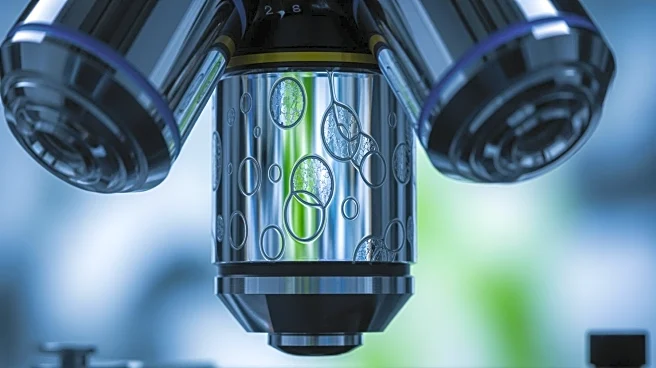
Researchers at the Istituto Italiano di Tecnologia in Genoa, Italy, have developed a new optical microscopy technique called super-resolution sectioning image scanning microscopy. This innovation allows
for the visualization and photography of dense, complex biological samples with unprecedented sharpness. Traditional confocal microscopy often struggles with a trade-off between spatial resolution and signal-to-noise ratio, especially in thick samples. The new technique overcomes these limitations by using an array of single-photon avalanche diode (SPAD) detectors, which can detect individual photons with high precision. This advancement not only improves resolution and optical sectioning but also enables advanced techniques like fluorescence lifetime imaging, crucial for exploring molecular dynamics in living tissues.
Why It's Important?
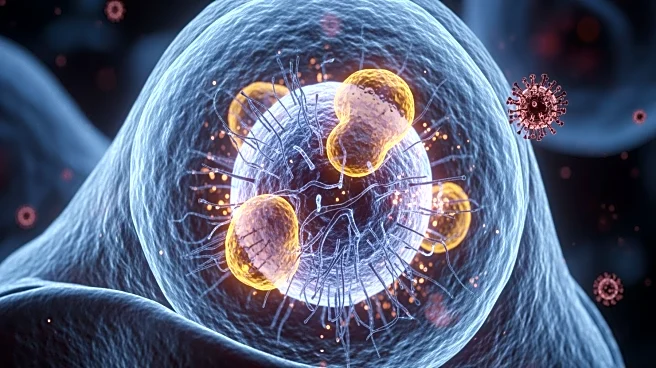
The development of super-resolution sectioning image scanning microscopy represents a significant leap forward in the field of biological imaging. By providing clearer and more detailed images of complex biological samples, this technique can enhance our understanding of cellular structures and functions. This has potential implications for a wide range of scientific fields, including oncology, neuroscience, and immunology, where detailed imaging is crucial for research and development. The ability to visualize biological samples in such detail could lead to breakthroughs in understanding diseases and developing new treatments.
What's Next?
The new microscopy technique has been made available to the scientific community under open science principles, suggesting that it will be widely adopted and further developed. Researchers are likely to explore its applications in various fields, potentially leading to new discoveries in disease mechanisms and treatment strategies. As the technique becomes more widely used, it may also inspire further innovations in microscopy and imaging technologies.
Beyond the Headlines
The introduction of this advanced microscopy technique could have long-term implications for the scientific community. By enabling more detailed and accurate imaging, it may change how researchers approach the study of complex biological systems. This could lead to a shift in research methodologies and priorities, emphasizing the importance of high-resolution imaging in scientific discovery.