

What's Happening?
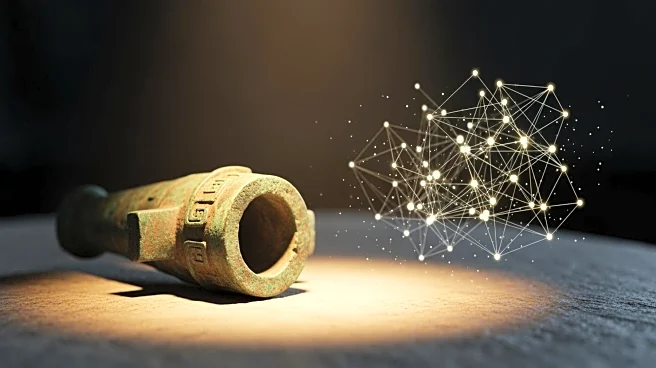
A recent study has introduced a novel framework utilizing Ladder-side Mixture of Experts (MoE) adapters to improve the recognition of bronze inscriptions. The research, conducted using PyTorch on a high-performance computing setup, focuses on enhancing
single-character recognition and full-page transcription of inscriptions. The framework employs 36 experts per layer in the MoE modules, which significantly boosts the model's ability to adapt to diverse inscription styles and cross-domain variations. The study highlights the importance of a large expert pool for effective MoE adapter functionality, allowing for specialization in rare character recognition. The research also explores the impact of Ordered Sequence Fine-tuning (OSF) epochs, showing that moderate-to-large OSF training enhances robustness, particularly for mid-frequency and rare classes.
Why It's Important?
This development is significant as it addresses the challenges of class imbalance and domain shifts in the field of historical text recognition. By improving the accuracy of bronze inscription recognition, the framework can aid in the preservation and study of ancient texts, providing valuable insights into historical contexts. The enhanced recognition capabilities could benefit archeologists and historians by offering a more reliable method for transcribing and analyzing ancient inscriptions. Additionally, the framework's ability to handle diverse visual domains and rare character patterns could be applied to other areas of text recognition, potentially influencing advancements in optical character recognition technologies.
What's Next?
Future research may focus on further optimizing the MoE adapters and exploring their application in other domains of text recognition. The study suggests that larger configurations of experts could offer additional gains, indicating a potential area for further exploration. Additionally, addressing the limitations observed in color and rubbing domains, such as surface corrosion and background noise, could enhance the robustness of the recognition model. Continued development in this area could lead to broader applications in digital humanities and the preservation of cultural heritage.
Beyond the Headlines
The study's approach to using a mixture of experts highlights a shift towards more specialized and adaptive machine learning models. This could influence future research in artificial intelligence, particularly in areas requiring high adaptability and specialization. The framework's success in handling long-tail distributions and cross-domain variations may inspire similar methodologies in other fields, promoting advancements in AI-driven recognition systems.