
What's Happening?
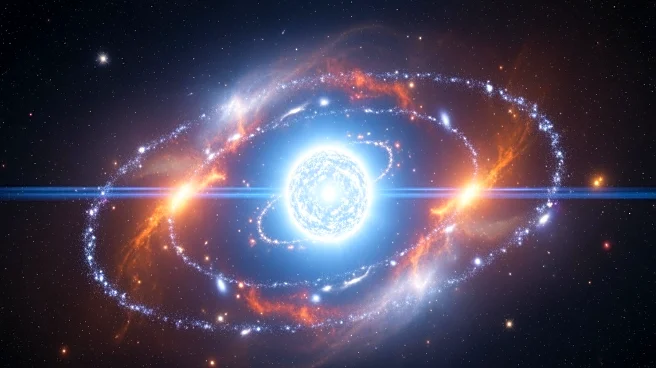
The star iPTF14hls, discovered in 2014, has defied astronomical expectations by exploding repeatedly over 1,000 days, maintaining a near-constant temperature. This behavior contradicts typical supernova
models, which predict a single explosion followed by cooling. The star, located 509 million light-years away, has shown hydrogen emissions despite multiple explosions, challenging existing theories about stellar behavior.
Why It's Important?
The unusual behavior of iPTF14hls presents a significant challenge to current astrophysical models, prompting a reevaluation of theories regarding supernovae and stellar evolution. Understanding this phenomenon could lead to new insights into the life cycles of massive stars and the processes that govern their explosions. The findings may influence future research priorities and the development of new models in astrophysics.
What's Next?
Astronomers will continue to study iPTF14hls to gather more data and refine hypotheses about its behavior. Advanced telescopes and observation techniques may be employed to monitor the star and similar phenomena. The scientific community may increase collaboration to develop new models that can explain the repeated explosions and their implications for stellar evolution.
Beyond the Headlines
The case of iPTF14hls highlights the limitations of current astronomical models and the need for innovative approaches to understanding complex cosmic phenomena. It underscores the importance of continuous observation and data analysis in advancing astrophysical knowledge. The findings may also inspire new theoretical frameworks and experimental methods in the study of stars and supernovae.