







What's Happening?
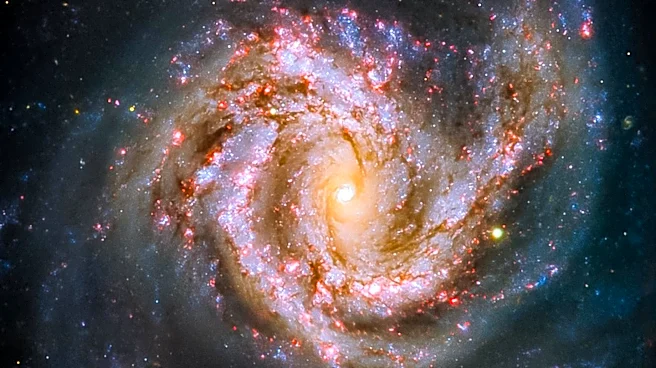
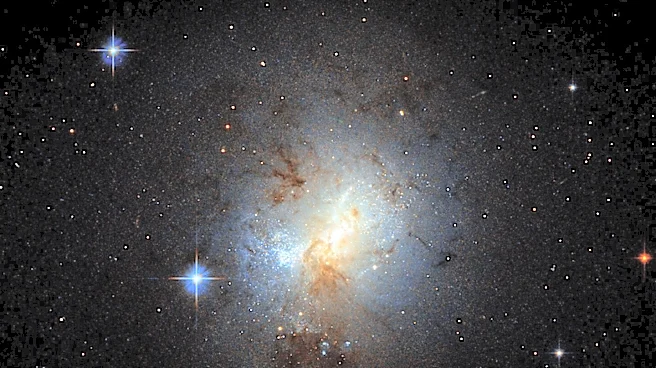
NSF NOIRLab, headquartered in Tucson, Arizona, with contributions from Lawrence Berkeley National Laboratory in California and other agencies, has released Data Release 11 (DR11), which is now the largest 2D map of the night sky ever created. This map covers
75% of the sky across 5.6 trillion pixels and catalogs 4 billion celestial objects, including stars, galaxies, black holes, and asteroids, observed in visible and near-infrared light. DR11 expands upon its predecessor, DR9, by 50% and reintroduces northern sky coverage that was absent in DR10. The map is based on 263,407 ground-based exposures collected by 160 scientists and has already been cited in over 1,800 research papers.
Why It's Important?
The release of DR11 is a monumental achievement in astronomy, providing an unprecedented resource for scientific research and public engagement. Its vast coverage and detailed catalog of 4 billion objects offer astronomers a comprehensive dataset to study the structure and evolution of the universe, identify new celestial bodies, and refine cosmological models. For the public, the interactive nature of the map allows anyone to explore the cosmos, fostering scientific literacy and inspiring interest in space. This map also laid the groundwork for identifying 60 million targets for the DESI project and contributed to the completion of a full 3D map in 2026, demonstrating its foundational role in ongoing and future astronomical endeavors.
What's Next?
With billions of targets still unstudied within DR11, researchers anticipate many new discoveries to emerge from its exploration. The map is expected to remain the premier 2D map of its kind for years, serving as a critical tool for astronomers worldwide. The public can access and interact with the map, using its features to search for celestial objects and explore the universe. Future developments may include enhanced user interfaces and integration with advanced AI tools to help users navigate and interpret the vast amount of data. The ongoing analysis of DR11 will continue to inform the DESI project and other initiatives aimed at creating even more detailed maps of the universe.
Beyond the Headlines
DR11 represents more than just a collection of data; it embodies humanity's enduring quest to understand its place in the cosmos. The collaborative effort of 160 scientists across multiple institutions highlights the global nature of modern scientific research. The map's accessibility to the public democratizes astronomy, allowing individuals to directly engage with scientific discovery. Furthermore, the presence of unmapped areas, such as those obscured by black holes or interstellar dust, serves as a powerful reminder of the universe's mysteries yet to be unveiled, pushing the boundaries of observational technology and theoretical physics. The ethical implications of mapping such vastness also touch upon our responsibility to preserve dark skies for future generations of stargazers and scientists.