




What's Happening?
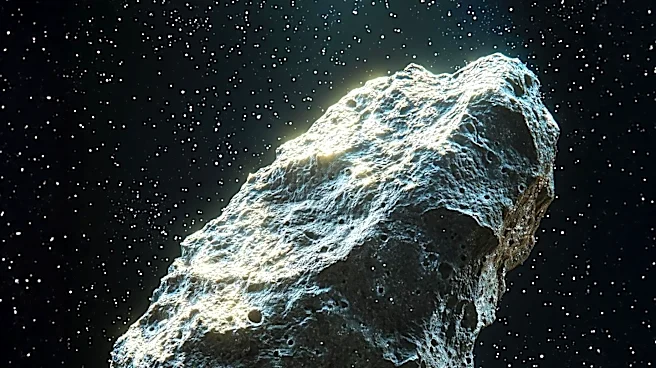
Astronomers have identified the first known triple-lobed asteroid, 44 Nysa, located in the asteroid belt between Mars and Jupiter. This discovery was made using advanced imaging techniques from the Large Binocular Telescope in Arizona and the Very Large Telescope in Chile.
The asteroid, which was initially discovered in 1857, was previously thought to be bi-lobed. However, recent observations have revealed that it has three distinct lobes and a small moon orbiting it. The moon, designated S/2026 (44) 1, is approximately 0.6 miles wide and orbits Nysa at a distance of at least 106 miles. The research team, led by Kate Minker from Arizona's Lowell Observatory, suggests that Nysa could either be a contact trinary, consisting of three connected components, or an irregular coherent body. The findings were achieved through the use of high-contrast imaging devices and adaptive optics to counteract atmospheric blurring.
Why It's Important?
The discovery of 44 Nysa's unique structure and its moon provides significant insights into the formation and evolution of asteroids in our solar system. Understanding the composition and structure of such asteroids can offer clues about the early solar system and the processes that led to the formation of planets, including Earth. Nysa's reflective surface, rich in enstatite, suggests it may have formed close to the sun, making it a potential building block of the inner planets. This discovery could help scientists refine models of asteroid formation and improve predictions about the behavior and characteristics of other celestial bodies. Additionally, studying Nysa's moon could provide further data on the asteroid's mass and density, aiding in distinguishing between different formation theories.
What's Next?
Future observations will focus on tracking the moon's orbital velocity and period to determine Nysa's exact mass and density. This data will help astronomers validate the current models of Nysa's formation. Continued study of Nysa and similar asteroids could enhance our understanding of the solar system's history and the conditions that existed during the formation of the inner planets. Researchers may also explore the potential for Nysa to provide insights into the materials and processes that contributed to Earth's development.