



What's Happening?
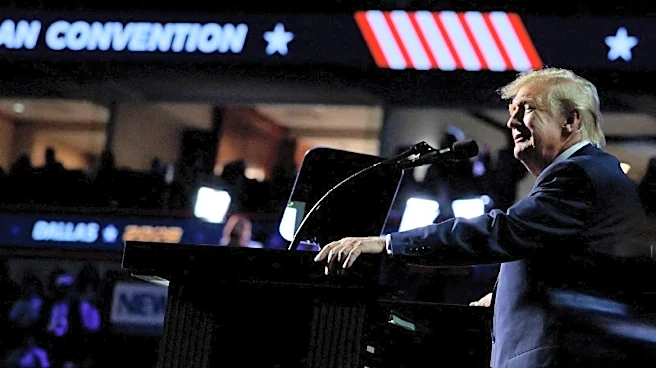
Senator Ted Cruz (R-TX) has expressed his preference for President Trump's proposed $5,000 dividend payment to Americans to be structured as a tax refund rather than a blanket payment. During an interview on Fox News Channel's 'Jesse Watters Primetime'
at the Republican National Convention in Dallas, Senator Cruz stated that he would support the proposal if it were designed to incentivize work. He emphasized that a tax refund would mean the money is 'most definitely their money,' referring to working Americans. Senator Cruz explicitly stated his opposition to paying individuals who are not working, particularly those 'physically able to work, but choosing not to.' He highlighted the importance of encouraging people to work and provide for their families, suggesting that a tax refund structure would align with Republican principles.
Why It's Important?
Senator Cruz's stance on President Trump's proposed dividend highlights a key ideological division within the Republican Party regarding economic policy and the role of government assistance. By advocating for a tax refund model, Senator Cruz emphasizes individual responsibility and work incentives, aligning with traditional conservative principles. This approach contrasts with a universal dividend, which could be perceived as a form of welfare or a less targeted distribution of funds. The debate over how to structure such a payment has significant implications for the U.S. economy, potentially affecting labor participation rates, consumer spending, and the national debt. A tax refund would primarily benefit working individuals and families, while a blanket payment would extend to all adults, including those not in the workforce. This discussion also reflects broader concerns about fiscal responsibility and the long-term economic impact of large-scale government payouts.
What's Next?
The debate over the structure of President Trump's proposed $5,000 dividend is likely to continue within Republican circles and potentially in Congress. Senator Cruz's proposal for a tax refund model could gain traction among fiscal conservatives who prioritize work incentives and targeted relief. The ultimate fate of the dividend plan will depend on further discussions, potential legislative proposals, and the political will to implement such a large-scale economic measure. If adopted, a tax refund structure would require careful consideration of eligibility criteria, income thresholds, and the administrative mechanisms for distribution. The outcome will also be influenced by the broader economic climate and the perceived need for direct financial assistance to Americans.
Beyond the Headlines
Senator Cruz's push to reframe President Trump's proposed dividend as a tax refund rather than a universal payment touches upon deeper philosophical debates about economic justice, individual liberty, and the social contract. By emphasizing that the money is 'their money' if structured as a tax refund, Cruz implicitly argues for a system where government returns what it has taken, rather than distributing new funds. This perspective reinforces the idea that wealth is primarily generated through individual effort and that government's role should be to facilitate, not supplant, that effort. The distinction between 'working' and 'not working' individuals also raises ethical questions about who deserves financial support and the societal value placed on different forms of contribution. This debate could influence future policy discussions on universal basic income, welfare reform, and the balance between social safety nets and market-driven incentives, shaping the long-term economic and social fabric of the U.S.