







What's Happening?
The European Council on Foreign Relations (ECFR) has issued a warning that Belarus is increasingly becoming an advanced operational military base for Russia, necessitating a change in the European Union's strategy. According to an analysis by Vasil Navumau,
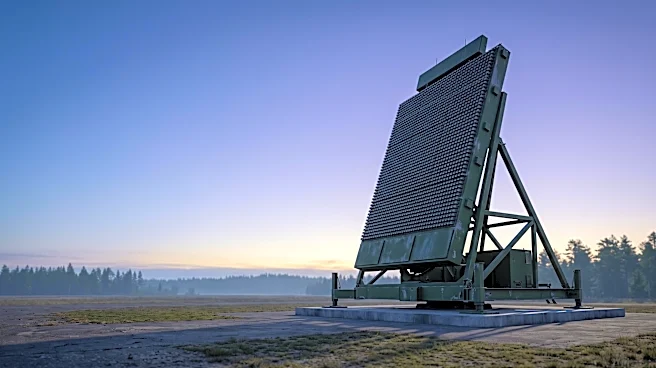
a researcher at the University of Siegen and former visiting fellow at ECFR, Belarus has transitioned from a logistical rear-operating base to a potential forward-operating base for Moscow. This shift involves the installation of Russian military infrastructure, missile systems, and nuclear capabilities on Belarusian territory. Approximately 2,000 Russian military personnel are reportedly concentrated around air defense systems, training centers, logistical hubs, and existing Russian military facilities in Belarus. The analysis highlights that the military relationship between Russia and Belarus has significantly deepened since the full-scale invasion of Ukraine in February 2022, with Belarus allowing its territory to be used for military equipment, aviation, railway infrastructure, hospitals, and airfields, and serving as a launch point for ground operations and missile attacks. The ECFR suggests that current EU policies, primarily based on sanctions and diplomatic isolation, risk increasing Belarus's dependence on Russia without resolving the issue of militarization.
Why It's Important?
This development is important because it signifies a substantial expansion of Russian military pressure along the European Union's eastern border, directly impacting the security landscape of the region. The transformation of Belarus into an advanced operational base for Russia, complete with nuclear capabilities and hypersonic missiles, brings Russian military assets closer to EU and NATO member states, increasing the risk of miscalculation and accidental escalation. The ECFR's critique of the current EU strategy suggests that sanctions, while intended to isolate Minsk, may inadvertently push Belarus further into Russia's orbit by reducing its economic alternatives and increasing its reliance on Moscow. This could undermine long-term efforts to maintain any degree of Belarusian autonomy. For the U.S. and its NATO allies, this situation necessitates a re-evaluation of regional defense strategies and potentially increased support for frontline states like Poland, Lithuania, and Latvia, which are now exposed to heightened military pressure, border incidents, and hybrid actions. The presence of Russian nuclear-capable systems in Belarus also raises significant concerns about nuclear proliferation and regional stability.
What's Next?
The ECFR recommends that the EU adopt a revised strategy that moves beyond exclusive reliance on sanctions and isolation. This new approach should focus on preventing the permanent and irreversible integration of Russian military presence in Belarus and limiting the deployment of Russian conventional and nuclear weapons. Key recommendations include strengthening support for Poland, Lithuania, and Latvia, maintaining diplomatic and technical contacts with Belarus, and conditioning any concessions on verifiable actions, such as the release of political prisoners. The analysis also suggests exploring ways to support independent economic capacity within Belarus and continuing support for Belarusian civil society and diaspora. The EU is urged to provide more stable funding for independent media, research organizations, and civic initiatives in exile. Furthermore, continued dialogue with the Belarusian political opposition, such as Sviatlana Tsikhanouskaya, is recommended to maintain political and civic infrastructure for potential future change. The goal is not immediate democratization or Western alignment, but rather to foster a Belarus autonomous enough to resist becoming a permanent Russian military platform and capable of managing relations with both Europe and Russia.
Beyond the Headlines
Beyond the immediate military implications, the ECFR's analysis delves into the ethical and strategic complexities of dealing with authoritarian regimes in geopolitical competition. The argument that sanctions, while morally justified, might inadvertently strengthen Russia's grip on Belarus highlights a critical dilemma in foreign policy: how to balance human rights concerns with strategic objectives. The comparison with the U.S.'s more transactional approach, which has seen limited humanitarian results but no change in Belarus's strategic alignment with Russia, underscores the difficulty of achieving desired outcomes. This situation also brings to light the long-term shifts in regional power dynamics, where the concept of a 'buffer state' is being eroded by deeper military integration. The emphasis on supporting civil society and independent economic initiatives within Belarus, even under repressive conditions, reflects a nuanced understanding of resilience and the potential for internal change, suggesting that long-term engagement with the Belarusian people, rather than just the regime, is crucial for future stability and autonomy.