


What's Happening?
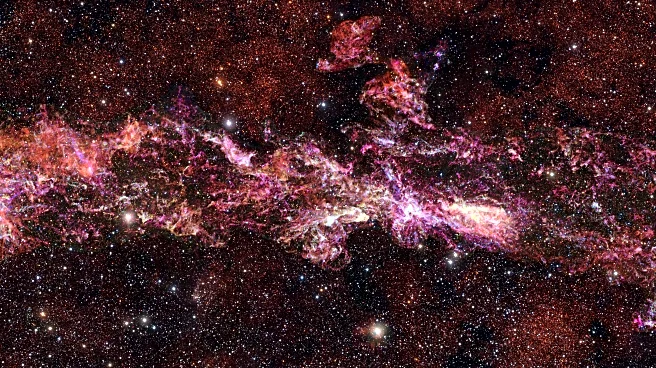
A telescope in Chile operated by the European Southern Observatory has captured an unprecedented image of the Milky Way galaxy's heart. The image focuses on a region of cold cosmic gases spanning over 650 light-years, surrounding the supermassive black
hole at the galaxy's center. This is the largest image ever taken by the ALMA antenna network located in the Atacama Desert. The study aims to enhance understanding of star formation and galaxy evolution, according to survey leader Steve Longmore from Liverpool John Moores University. The image reveals the swirling beauty of star-forming gases, providing astronomers with new insights into the extreme conditions present in the galaxy's core.
Why It's Important?
The detailed image of the Milky Way's heart is significant for astronomers studying galaxy formation and evolution. By understanding the processes occurring in the Central Molecular Zone, scientists can gain insights into how galaxies develop over time. This research could lead to advancements in astrophysics and improve our comprehension of cosmic phenomena. The findings may also contribute to the broader field of space exploration, potentially influencing future missions and technologies aimed at exploring distant galaxies.