






What's Happening?
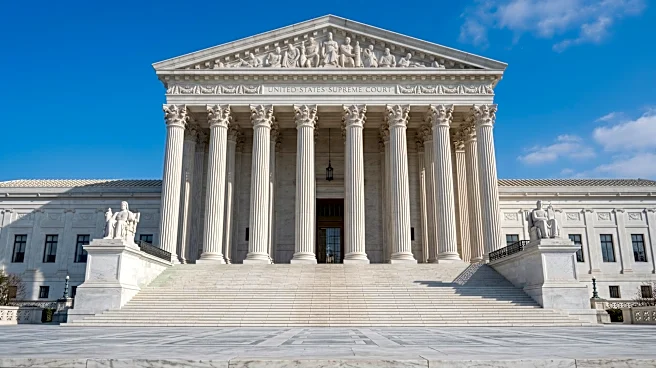
Alaska lawmakers, who previously rejected Stephen Cox as attorney general due to his extensive use of amicus briefs, have now decided to file one of their own with the U.S. Supreme Court. The Legislature's hired attorney is expected to submit a 'letter'—a
term used to soften the perception of an amicus brief—to the Supreme Court by mid-October. This decision comes after lawmakers, including Rep. Sara Hannan, D-Juneau, and Sen. Jesse Kiehl, D-Juneau, criticized Cox for participating in over 100 amicus briefs, which they viewed as engaging in 'Lower 48 culture wars' rather than focusing on Alaska-specific issues. The current brief supports the State of Alaska in the case of *Jouppi v. Alaska*, which concerns the state's ability to seize property, specifically an airplane, in cases of illegal alcohol importation into dry communities.
Why It's Important?
This reversal by Alaska lawmakers highlights a significant political and legal dynamic, demonstrating how the perceived utility of legal tools can shift based on specific circumstances and political alignment. The initial rejection of Stephen Cox underscored a legislative desire for the state's top legal officer to prioritize local issues over broader national legal debates. However, the decision to file an amicus brief in *Jouppi v. Alaska* indicates that lawmakers now recognize the importance of influencing federal court decisions that directly impact state policy and sovereignty, particularly concerning issues like alcohol control in rural communities. This case could set a precedent for how states can enforce laws against illegal importation and the extent of property forfeiture, affecting similar policies nationwide.
What's Next?
The Legislature's attorney will submit the amicus brief to the U.S. Supreme Court by mid-October, ahead of oral arguments scheduled for December 1 in *Jouppi v. Alaska*. The Supreme Court's ruling will determine how courts measure the seriousness of an offense when assessing whether a forfeiture is 'grossly disproportional' under the Eighth Amendment's Excessive Fines Clause. A ruling in favor of Jouppi could mandate more individualized reviews for property seizures across the country, potentially limiting governmental power in such cases. Conversely, a ruling for Alaska could strengthen the ability of legislatures to impose stringent forfeiture penalties for conduct deemed highly damaging, particularly in the context of public health and safety. This decision will have far-reaching implications for legal precedent and state legislative authority.
Beyond the Headlines
This situation reveals a deeper tension between local governance and national legal principles, particularly regarding the balance between state autonomy and individual rights. The initial criticism of Cox for engaging in 'culture wars' reflects a desire to keep state legal resources focused on immediate Alaskan concerns. However, the subsequent decision to file an amicus brief in a case with national implications demonstrates that even locally focused lawmakers recognize the interconnectedness of state and federal legal systems. The *Jouppi v. Alaska* case, while seemingly about an airplane and alcohol, touches upon fundamental questions of property rights, the scope of government power, and the interpretation of constitutional protections, making it a pivotal case for legal scholars and policymakers across the U.S. The Legislature's shift in approach also underscores the pragmatic nature of politics, where principles can be re-evaluated when self-interest or critical state issues are at stake.