








What's Happening?
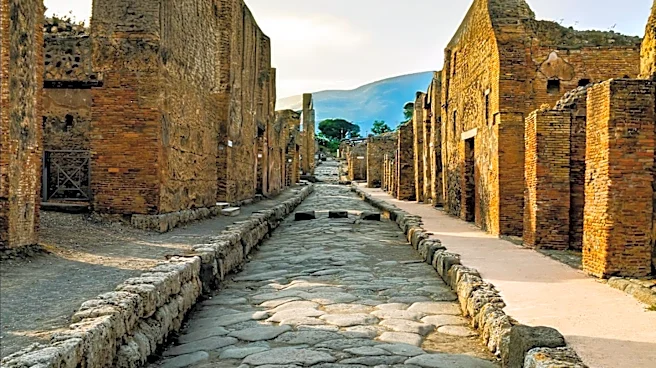
A new study published in Nature Communications is challenging the long-held saying, 'All roads lead to Rome,' by analyzing the Roman Empire's extensive road network. Researchers, led by classical archaeologist Tom Brughmans of Aarhus University in Denmark,
mapped approximately 190,000 miles of Roman roads across Europe, the Middle East, and North Africa. Their findings suggest that while Rome was undoubtedly a central hub, provincial capitals also played crucial roles in overland travel. Notably, Constantinople (modern-day Istanbul, Turkey) emerged as a far more central hub for overland travel after Emperor Constantine made it the imperial capital in the fourth century AD, due to its strategic location between Europe and Asia. The study indicates that the proverb, which originated centuries after the Roman Empire's fall, does not fully capture the complexity of the empire's transportation infrastructure, with many roads leading to various important centers.
Why It's Important?
This study significantly re-evaluates our understanding of the Roman Empire's logistical and administrative structure. By demonstrating the decentralized nature of its road network, it highlights the critical importance of provincial capitals in facilitating movement and trade across the vast empire. This challenges a long-standing historical narrative that overemphasizes Rome's singular centrality, offering a more nuanced view of Roman governance and economic integration. For historians and archaeologists, these findings necessitate a re-examination of how resources, information, and military forces were distributed and managed. It also underscores the strategic foresight in establishing cities like Constantinople, whose geographical advantage allowed it to become a dominant logistical nexus. The research provides a valuable lesson in critically assessing historical maxims and using modern analytical tools to uncover deeper truths about ancient civilizations, impacting how we interpret historical power dynamics and urban development.
What's Next?
The findings of this study are likely to stimulate further research into the specific roles and connectivity of various provincial capitals within the Roman Empire. Historians and archaeologists may delve deeper into regional road networks, trade routes, and administrative centers to understand their individual significance and their collective contribution to the empire's cohesion. Future studies could also explore the economic and social implications of this decentralized connectivity, examining how it fostered regional development and cultural exchange. The research may also prompt a broader re-evaluation of other historical proverbs and common understandings, encouraging the application of advanced data analysis to historical datasets. This could lead to a more comprehensive and accurate mapping of ancient infrastructures and their impact on societal organization.
Beyond the Headlines
The re-evaluation of 'All roads lead to Rome' extends beyond historical accuracy, touching upon the power of narrative and the persistence of cultural myths. This proverb has long symbolized centralized power and singular importance, influencing not just historical understanding but also modern metaphors for ambition and focus. The study's findings suggest that even in seemingly monolithic empires, complexity and distributed networks were crucial for functionality. This resonates with contemporary discussions about decentralization, network theory, and the importance of regional hubs in global systems. It subtly challenges the idea of a single, all-encompassing center, suggesting that even ancient power structures relied on a more distributed model than commonly perceived. This shift in understanding can encourage a more critical approach to historical narratives and a greater appreciation for the multifaceted nature of historical and contemporary systems.