







What's Happening?
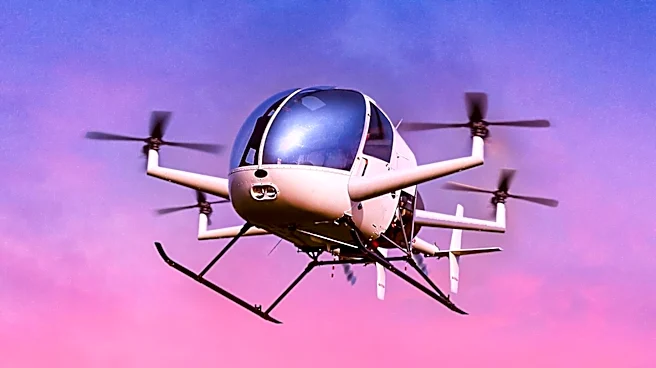
U.S. Transportation Secretary Sean P. Duffy celebrated North Carolina's inaugural demonstration flight under the USDOT's Advanced Air Mobility Integration Pilot Program (eIPP). This initiative marks North Carolina as the fifth location to launch such
a program, following Texas. The eIPP, established under President Trump, aims to create extensive real-world testing environments for electric vertical takeoff and landing aircraft (eVTOLs), autonomous planes, and drone technology. Senator Ted Budd of North Carolina expressed his enthusiasm, highlighting the state's historical connection to aviation and its role in fostering advanced air mobility technologies. The program involves collaborations between Joby Aviation, BETA Technologies, and the North Carolina Department of Transportation to test regional flight and medical transport capabilities. Recent test flights included Joby's remotely piloted J208 flying from Dare County Regional Airport to Raleigh-Durham International Airport, and BETA's electric ALIA aircraft conducting multiple flights between Raleigh Executive Jetport, Pitt-Greenville Airport, and Dare County Regional Airport.
Why It's Important?
This federal eVTOL pilot program is significant for several reasons. It positions the United States, and specifically North Carolina, at the forefront of advanced air mobility innovation, potentially creating new jobs and connecting communities. The data gathered from these pilot projects will be crucial for the Federal Aviation Administration (FAA) in developing new regulations to safely integrate these futuristic aircraft into the national airspace. This initiative could transform how Americans travel and transport goods, offering solutions for regional economies, reducing transit costs, and improving access to essential services, particularly in rural areas. The program's focus on medical and disaster response missions demonstrates its potential to enhance critical infrastructure and emergency services, making it a vital step towards a more connected and resilient transportation system. The involvement of private industry alongside federal and state governments underscores a collaborative approach to technological advancement.
What's Next?
The North Carolina Department of Transportation and other eIPP participants are planning additional test flights throughout the remainder of the year. These ongoing demonstrations will continue to gather critical data and insights necessary for the FAA to formulate comprehensive regulations for advanced air mobility. The eIPP, which encompasses eight selected projects across 28 states, will continue to explore various applications, including urban air taxi services, regional passenger transportation, cargo and logistics networks, emergency medical response operations, autonomous flight technologies, and offshore/energy-sector transportation. The ultimate goal is to safely and efficiently integrate these new aircraft into the national airspace, building on the advanced air mobility strategy launched by Secretary Duffy and the FAA. This will pave the way for the widespread adoption of eVTOLs and other advanced aviation technologies, potentially revolutionizing air travel and logistics.
Beyond the Headlines
The launch of the federal eVTOL pilot program in North Carolina represents more than just technological advancement; it signifies a broader shift in the national approach to transportation and innovation. By actively testing and integrating these new aircraft, the U.S. is not only aiming to maintain its leadership in aviation but also to address long-standing challenges such as rural connectivity and efficient emergency response. The program's emphasis on data collection for regulatory development highlights a proactive and safety-first approach to emerging technologies, ensuring that innovation is balanced with public welfare. Furthermore, the collaboration between government agencies, private companies, and state entities sets a precedent for future public-private partnerships in developing cutting-edge infrastructure. This initiative could also inspire educational and workforce development programs to prepare for the demands of a new aviation industry, fostering a skilled labor force capable of supporting advanced air mobility operations and maintenance.