








What's Happening?
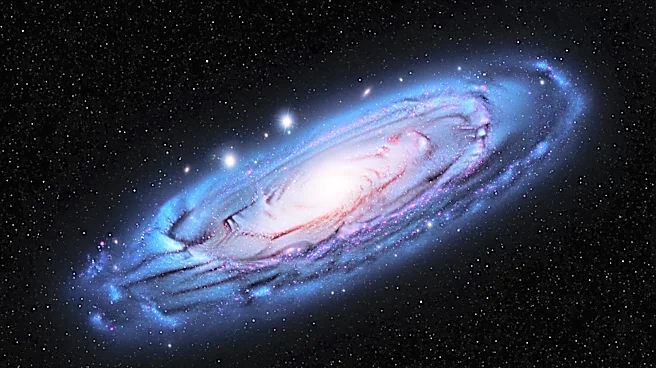
NASA's Hubble Space Telescope has captured an image of the galaxy NGC 1266, located approximately 100 million light-years away in the constellation Eridanus. This lenticular galaxy is characterized by a bright center and a face that suggests a spiral
structure, although it lacks distinct spiral arms. The image reveals reddish-brown clumps and filaments of dust that partially obscure the galaxy's face, with light from distant galaxies visible through its outer regions. Lenticular galaxies like NGC 1266 are considered transitional, bridging the evolutionary gap between spiral and elliptical galaxies. They possess a bright central bulge and a flattened disk similar to spirals but lack spiral arms and have minimal star formation, akin to ellipticals.
Why It's Important?
The study of transitional galaxies like NGC 1266 is crucial for understanding the evolutionary processes of galaxies. By examining these galaxies, astronomers can gain insights into the transformation from spiral to elliptical forms, which has implications for the broader understanding of galactic evolution. This research can help scientists comprehend the lifecycle of galaxies and the factors influencing their development. The findings from such studies contribute to the broader field of astrophysics, enhancing our knowledge of the universe's structure and the dynamics of celestial bodies.