
What's Happening?
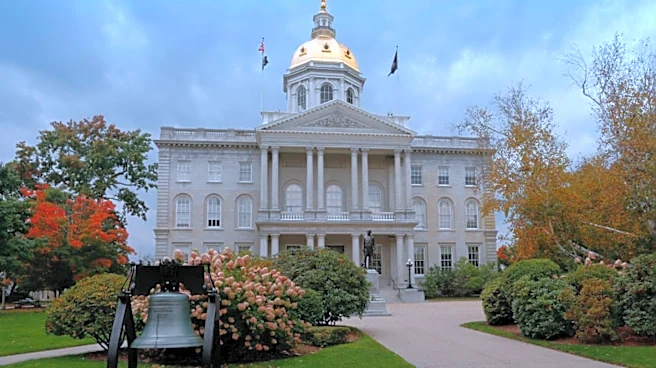
The New Hampshire Supreme Court has transitioned to an entirely Republican composition, a departure from its historical bipartisan balance. This shift has occurred under Governors Chris Sununu and Kelly
Ayotte, who have exclusively nominated Republican members to the state's highest court. Previously, governors often maintained a 3-2 split along party lines, sometimes even nominating members of the opposing party to ensure bipartisanship. The current situation means all five justices are now Republicans, at a time when the court faces increased public scrutiny. This includes controversies surrounding Chief Justice Gordon MacDonald, who is currently on indefinite medical leave, and allegations of ethical violations involving Justice Anna Barbara Hantz Marconi. The Judicial Selection Commission has also been made all-Republican by executive order, further solidifying the partisan alignment of judicial appointments.
Why It's Important?
This partisan shift in the New Hampshire Supreme Court is significant because it raises questions about judicial independence and the court's ability to objectively interpret state law. Historically, a bipartisan court developed a body of law that created state constitutional rights more protective than those under the federal constitution. Critics, such as Albert 'Buzz' Scherr, a constitutional law professor, suggest that the current court may be less attentive to states' rights. The lack of diversity in appointments, with outstanding lawyers from various backgrounds being overlooked, further fuels concerns about potential biases. The court is currently handling long-standing and controversial matters, including education funding cases like the Claremont decisions. The Attorney General has filed a brief arguing for the overturning of these decisions, which have been foundational to the state's education system for three decades. A partisan court could significantly alter the legal landscape of New Hampshire, impacting critical areas like education, civil rights, and the balance of power within the state.
What's Next?
The New Hampshire Supreme Court is expected to continue hearing cases, including the appeal of the Rand decision, which challenges the state's education funding system. The absence of Chief Justice Gordon MacDonald due to medical leave means four justices will decide cases, with four of the five justices having refused to recuse themselves despite prior involvement or statements related to the Claremont decisions. The Judicial Conduct Committee has charged Justice Anna Barbara Hantz Marconi with ethical violations, and a public hearing in December will likely address allegations regarding her interactions with the governor while her husband was under criminal investigation. The ongoing public scrutiny and the all-Republican composition of the court suggest that future rulings, particularly on contentious issues, will be closely watched for any perceived partisan influence. The long-term implications for state constitutional rights and the perception of judicial objectivity in New Hampshire remain to be seen.
Beyond the Headlines
The shift to an all-Republican New Hampshire Supreme Court highlights a broader national trend of increasing politicization within the judiciary. While judges are expected to rule objectively, the process of judicial appointments, particularly at the state level, often reflects the political leanings of the appointing governor. This situation in New Hampshire underscores the delicate balance between political appointments and the need for an impartial judiciary. The concern is not necessarily that Republican judges are inherently biased, but that a lack of diverse perspectives—both political and professional—on the bench could lead to a narrower interpretation of laws and rights. This could erode public trust in the judiciary and potentially lead to a perception that legal outcomes are predetermined by political affiliation rather than legal merit. The long-term impact could be a weakening of state constitutional protections and a more homogenous legal philosophy dominating the state's highest court.