



What's Happening?
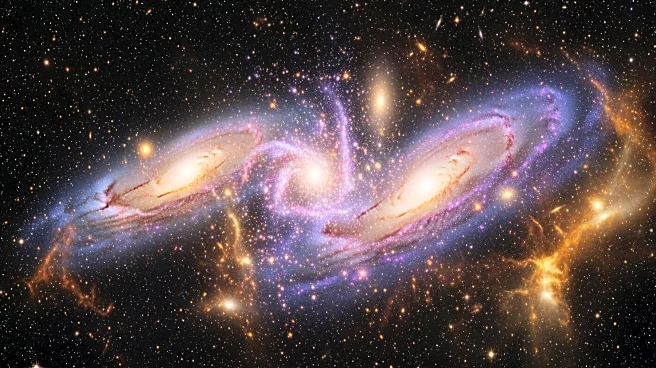
NASA's Chandra X-ray Observatory, along with optical telescopes, has captured a new image of a galaxy cluster known as the 'Champagne Cluster.' Discovered on December 31, 2020, the cluster is actually two galaxy clusters in the process of merging. The
image reveals superheated gas, represented in purple, and the bubble-like appearance of the galaxies, which inspired the cluster's nickname. The merging clusters contain multimillion-degree gas and large amounts of dark matter. The Chandra data, combined with optical data from the Legacy Surveys, shows the clusters' hot gas and individual galaxies. The clusters are in a rare class of merging clusters, similar to the well-known Bullet Cluster. Researchers are using computer simulations to understand the history of the Champagne Cluster, considering scenarios of past collisions. The study aims to provide insights into how dark matter reacts to high-speed collisions.
Why It's Important?
The discovery and study of the Champagne Cluster are significant for understanding the dynamics of galaxy cluster mergers and the behavior of dark matter. These clusters are among the largest structures in the universe, and their study can reveal how galaxies and dark matter interact during collisions. The presence of dark matter, which outweighs the visible matter, is crucial for understanding the universe's composition. The research can also provide insights into the formation and evolution of galaxy clusters, which are key to understanding the large-scale structure of the universe. The findings may have implications for cosmology and the study of dark matter, a mysterious substance that makes up a significant portion of the universe's mass.
What's Next?
Further studies of the Champagne Cluster are expected to continue, with researchers aiming to refine their understanding of the cluster's history and the role of dark matter in galaxy cluster mergers. Additional observations and simulations may help clarify the sequence of events leading to the current state of the cluster. The ongoing research could also contribute to broader studies of galaxy cluster dynamics and the properties of dark matter. As the Chandra X-ray Observatory and other telescopes continue to observe similar clusters, scientists hope to gather more data to test their models and theories about the universe's structure and evolution.