
What's Happening?
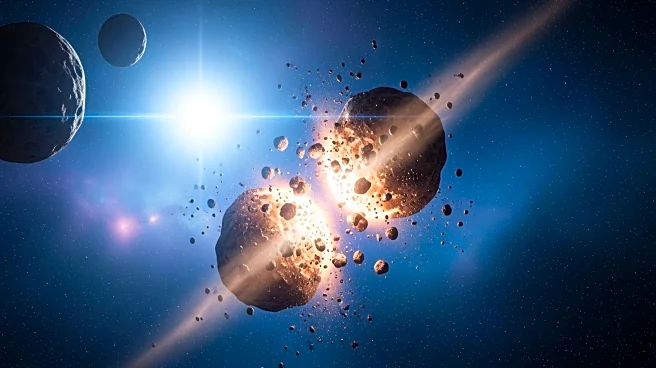
Astronomers have observed a collision between two large asteroids around the nearby star Fomalhaut, providing a rare opportunity to study such events in real time. This discovery helps solve the mystery of Fomalhaut b, previously thought to be a giant
planet, but now believed to be a cloud of debris from asteroid collisions. The new bright spot, Fomalhaut cs2, is likely a dust cloud resulting from the collision of two planetesimals, each about 60 kilometers in diameter. This observation challenges previous theories that such collisions are rare, suggesting they may be more common around young stars like Fomalhaut. The findings offer a glimpse into the processes that may have occurred in the early solar system, providing valuable data for understanding planetary formation.
Why It's Important?
The observation of asteroid collisions around Fomalhaut is significant for several reasons. It provides direct evidence of the dynamic processes that shape young planetary systems, offering insights into the early stages of solar system development. Understanding these collisions can help scientists draw parallels between Fomalhaut's system and our own, shedding light on the conditions that led to the formation of planets and moons. The findings also suggest that such collisions may be more frequent than previously thought, prompting a reevaluation of existing models of planetary system evolution. This research could lead to a better understanding of the frequency and impact of similar events in other star systems, enhancing our knowledge of the universe's formation and evolution.
What's Next?
Researchers, including Paul Kalas and his team, plan to continue observing Fomalhaut using the Hubble Space Telescope and the James Webb Space Telescope over the next three years. These observations aim to monitor the behavior of Fomalhaut cs2 and search for the now-dimmer Fomalhaut b. The ongoing study will provide further insights into the frequency and nature of asteroid collisions in young planetary systems. As more data is collected, scientists hope to refine their understanding of these processes and their implications for planetary formation. The research may also inform future missions and studies focused on similar phenomena in other star systems.