


What's Happening?
Representative Joyce Beatty, an Ohio Democrat and ex officio member of the Kennedy Center, has filed an emergency request with a federal court to prevent the Kennedy Center from re-inscribing President Trump's name on its facade. This action follows a vote
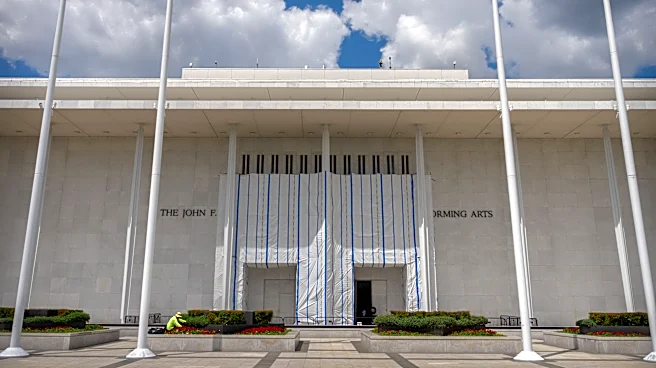
by the Trump-aligned Kennedy Center board to add the inscription, 'The John F. Kennedy Center for the Performing Arts Restored and Renovated By President Donald J. Trump,' and potentially another if the Trump Kennedy Center Fund reaches $100 million. The board also proposed renaming the plaza in front of the center to recognize President Trump. This move comes after U.S. District Court Judge Christopher Cooper ruled in May that the Kennedy Center illegally added President Trump's name, ordering its removal. The institution complied in June but left scaffolding and a tarp in place. Beatty's lawyers argue that the board's recent actions constitute 'clear violations' of the earlier court order. The Kennedy Center has stated it will not engrave President Trump's name before September 8, allowing legal arguments to proceed.
Why It's Important?
This legal challenge highlights a significant conflict regarding the interpretation and enforcement of federal law concerning national memorials and the authority of appointed boards. Congress designated the Kennedy Center as a living memorial to President John F. Kennedy in 1964, explicitly prohibiting the board of trustees from memorializing anyone else or placing another person's name on the building's exterior. The Kennedy Center board's resolution, supported by President Trump's allies, claims the center would face 'financial ruin' without President Trump's 'unparalleled fundraiser and world-class developer' stature. This dispute underscores broader tensions between political appointments and established legal frameworks governing public institutions. The outcome will set a precedent for how future administrations and their appointees can interact with and potentially alter the historical and legal designations of national landmarks, impacting the integrity of such institutions and the rule of law.
What's Next?
The federal court will now consider Representative Beatty's emergency request to block the Kennedy Center's plans. Judge Christopher Cooper has set a rapid briefing schedule, with deadlines by August 26, to address the issue. The Kennedy Center has committed not to engrave President Trump's name on the building before September 8, allowing time for the legal arguments to unfold. The court's decision will determine whether the Kennedy Center board's actions are deemed a violation of the previous court order and federal law. Depending on the ruling, the Kennedy Center may be permanently barred from adding President Trump's name, or the board's resolution could proceed. This case could also lead to further legal challenges regarding the authority of presidential appointees over national institutions and their adherence to judicial rulings.
Beyond the Headlines
This situation extends beyond a simple naming dispute, touching upon the ethical implications of memorializing political figures on national institutions and the potential for political influence to override established legal and historical precedents. The argument that the Kennedy Center would face 'financial ruin' without President Trump's involvement raises questions about the financial independence and fundraising practices of national cultural institutions. Furthermore, the Kennedy Center's decision to leave scaffolding and a tarp in place after the initial court order suggests a deliberate strategy to maintain the possibility of re-inscribing the name, potentially undermining judicial authority. This ongoing legal battle could influence how future administrations approach the naming and renovation of public buildings, potentially leading to increased scrutiny of board appointments and their adherence to the founding principles of national landmarks.