



What's Happening?
NASA has decided to adopt a simpler spacesuit design for its initial lunar surface missions, a move aimed at accelerating the Artemis program's goal of landing humans at the Moon's south pole as early as 2028. This decision was announced during an internal
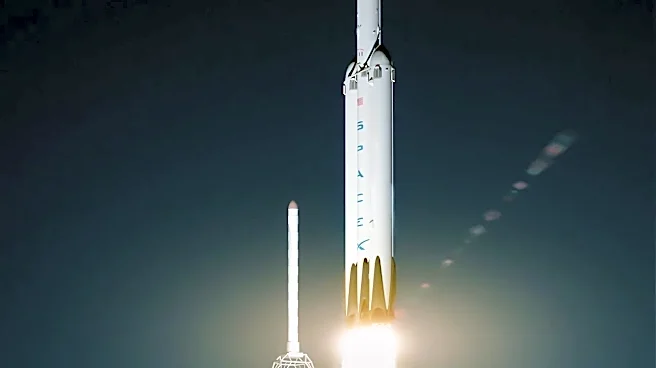
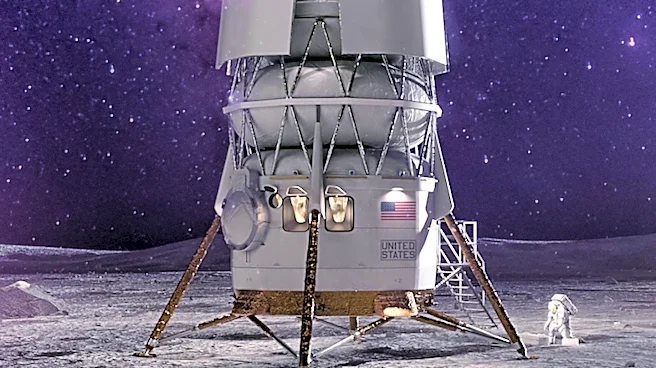
meeting by Artemis Program Manager Jeremy Parsons. The agency will collaborate with Axiom Space to develop a 'Sortie Suit' variant of the previously planned spacesuit. The primary objectives for this new design are to reduce the spacesuit's mass and complexity, and to simplify the interfaces between the spacesuits and lunar landers. This initiative comes after concerns about the progress rate of spacesuit development. Approximately four years ago, NASA awarded spacesuit development contracts to two providers, Axiom Space and Collins Aerospace. However, Collins Aerospace withdrew in 2024, leaving Axiom as the sole provider. The Sortie Suit is intended for use in initial landing missions, which will utilize landers developed by both SpaceX and Blue Origin.
Why It's Important?
This strategic shift by NASA underscores the critical role of spacesuit technology in achieving its lunar exploration objectives and highlights the challenges inherent in complex space missions. By simplifying the spacesuit design, NASA aims to mitigate delays and cost overruns that could jeopardize the ambitious Artemis IV timeline. The decision to streamline the suit's features reflects a pragmatic approach to mission planning, prioritizing functionality and timely deployment over more advanced, but potentially more time-consuming, developments. This could have significant implications for the U.S. space industry, particularly for companies like Axiom Space, which now bears the sole responsibility for delivering these crucial components. The success of the Sortie Suit will not only enable astronauts to conduct vital scientific research and exploration on the lunar surface but also demonstrate NASA's ability to adapt and innovate under pressure, maintaining the nation's leadership in space exploration. Conversely, any further delays or technical issues with the simplified suit could set back the entire Artemis program, impacting scientific progress and international partnerships.
What's Next?
NASA will proceed with the development of the 'Sortie Suit' variant in collaboration with Axiom Space, focusing on reducing mass, complexity, and improving interfaces with lunar landers. The progress of this development will be closely monitored, as it is crucial for the Artemis IV mission's target of a 2028 lunar landing. Stakeholders, including SpaceX and Blue Origin, whose landers will be used in these initial missions, will need to ensure seamless integration with the new spacesuit design. The success of this simplified approach could influence future spacesuit development strategies for longer-duration lunar missions or even Mars exploration. The space community will be watching for updates on the suit's design, testing phases, and its impact on the overall Artemis program schedule. Any further announcements regarding the 'Sortie Suit's' capabilities or potential challenges will be key indicators of the program's trajectory.
Beyond the Headlines
The decision to simplify the lunar spacesuit design reflects a broader tension in complex technological endeavors: the balance between ambitious innovation and practical feasibility. While advanced spacesuits offer enhanced capabilities, their development often entails significant time, cost, and technical hurdles. NASA's pivot to a 'Sortie Suit' suggests a recognition that achieving the immediate goal of lunar presence requires a more streamlined, perhaps less feature-rich, solution. This could set a precedent for future space missions, where modularity and adaptability in equipment design might be prioritized over all-encompassing, highly complex systems. Ethically, it raises questions about the trade-offs between astronaut safety and mission timelines, though the simplification is aimed at ensuring timely and safe deployment. Culturally, it reinforces the narrative of human ingenuity and resilience in overcoming obstacles to space exploration, even if it means adjusting initial grand visions for more achievable steps. This pragmatic shift could also influence how other space agencies and private companies approach their own equipment development, fostering a more agile and iterative design philosophy in the burgeoning space industry.