




What's Happening?
Louisiana Governor Jeff Landry has publicly criticized New Orleans Mayor Helena Moreno for not acknowledging him or President Trump regarding the deployment of the National Guard in New Orleans. The criticism arose after Mayor Moreno issued a statement
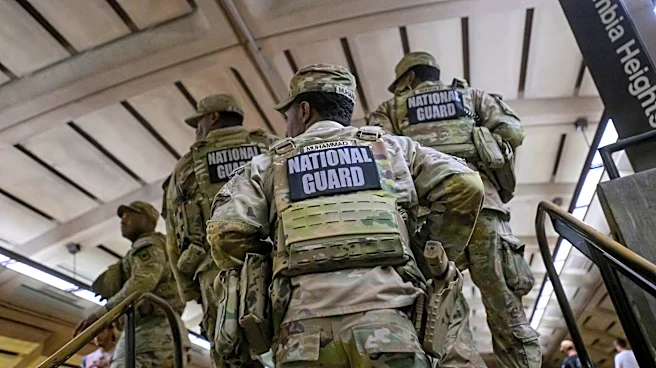
thanking the National Guard members and their families as the troops began their withdrawal from the city, but did not specifically mention Governor Landry or President Trump. Governor Landry took to social media to express his displeasure, stating that he and President Trump were responsible for the National Guard's presence, which he referred to as 'Troop NOLA' or the 'National Guard Operation.' He further asserted that city leadership must take responsibility for public safety, despite his commitment to making the state safer, including New Orleans. The National Guard's deployment, which began at the end of last year under President Trump's orders, is scheduled to conclude by August 31.
Why It's Important?
This public disagreement highlights ongoing tensions between state and city leadership in Louisiana, particularly concerning public safety initiatives and political credit. The withdrawal of the National Guard, which the Metropolitan Crime Commission President Rafael Goyeneche credited with contributing to a 70% drop in violent crime since 2022, raises questions about the future of crime reduction efforts in New Orleans. Governor Landry's insistence on city leaders taking responsibility for public safety underscores a broader debate about the division of duties and resources between state and local governments. The incident also reflects the political dynamics surrounding federal and state interventions in local issues, where the attribution of success or failure can become a point of contention. The departure of the Guard could place increased pressure on the New Orleans Police Department and Louisiana State Police to maintain the recent crime reduction trends.
What's Next?
As the National Guard completes its withdrawal by August 31, the focus will shift to how New Orleans city leadership, particularly Mayor Moreno, will address public safety without the Guard's presence. Governor Landry has indicated a willingness to work with the city on public safety, but emphasized the need for a 'true partnership' and for city leadership to 'do its part.' This suggests that future collaborations may be contingent on a more cooperative stance from the city, at least from the Governor's perspective. The ongoing dialogue between state and city officials will likely continue, with public safety remaining a central issue. The effectiveness of the New Orleans Police Department and Louisiana State Police in maintaining crime reduction efforts post-Guard deployment will be closely monitored by both state and local stakeholders, as well as the public.
Beyond the Headlines
This incident goes beyond a simple political spat, touching upon the complex interplay of federal, state, and local governance in addressing critical issues like public safety. The deployment of the National Guard, initially ordered by President Trump, signifies a federal intervention in local crime, raising questions about the appropriate scope of such actions and their long-term sustainability. The subsequent withdrawal and the ensuing political friction highlight the challenges of transitioning from external support to local self-sufficiency in maintaining order. Furthermore, the debate over who deserves credit for crime reduction can overshadow the substantive efforts and resources required to achieve and sustain such outcomes. This situation could set a precedent for how similar inter-governmental collaborations are perceived and managed in other U.S. cities facing public safety challenges, emphasizing the need for clear communication and shared responsibility rather than political posturing.