



What's Happening?
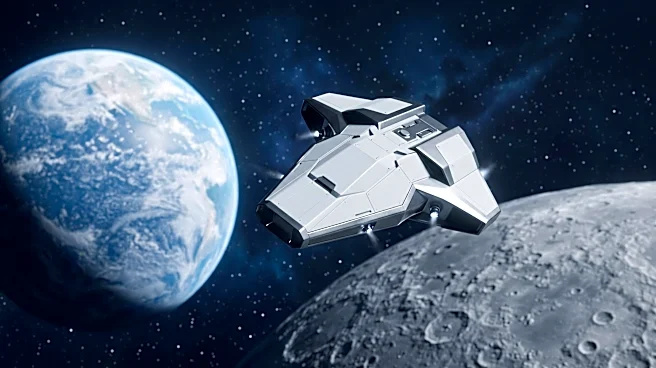
Chinese aerospace researchers have published a study exploring the potential for terrestrial conflicts to extend into the vast cislunar space, the region between Earth and the Moon. The study, detailed in the Chinese-language Journal of Command and Control,
models scenarios where rival spacecraft engage in evasive maneuvers, pursue each other, bypass defenses, and even block strategic routes. According to a team from Northwestern Polytechnical University in Xian, spacecraft could utilize the Moon's complex gravitational environment to hide, making their trajectories difficult to predict, before emerging to target objects closer to Earth. Additionally, these craft could be positioned at 'choke points'—areas where crucial or fuel-efficient routes converge—to intercept adversaries, potentially forcing them into less efficient paths or requiring them to break through. The researchers argue that such capabilities could exert influence without direct confrontation, compelling adversaries to alter mission plans, incur higher costs, or delay operations.
Why It's Important?
This study highlights a growing concern among spacefaring nations regarding the militarization of cislunar space. For the United States, which has significant interests in lunar exploration and potential resource utilization, these findings underscore the need for robust space situational awareness and defensive capabilities in this region. The ability of rival powers to conceal spacecraft or control strategic orbital pathways could jeopardize future U.S. lunar missions, including planned Moon bases and resource extraction efforts. The concept of 'choke points' in cislunar space introduces a new dimension to strategic competition, potentially impacting access to the Moon and beyond. This research suggests that future conflicts may not be confined to Earth's atmosphere or low Earth orbit, but could extend to the Moon's vicinity, necessitating a re-evaluation of national security strategies in space and increased investment in cislunar domain awareness and protection.
What's Next?
The publication of this study by Chinese researchers is likely to prompt increased attention and strategic planning from other major space powers, including the United States. It could accelerate discussions within defense and space agencies about developing countermeasures and enhancing capabilities for operating securely in cislunar space. This might include investments in advanced tracking systems, more resilient spacecraft designs, and potentially the development of defensive space assets. Furthermore, the study could fuel international debates on the need for new arms control treaties or norms of behavior specifically for cislunar space, to prevent the weaponization of this critical region. The U.S. and its allies may also increase their focus on developing technologies that allow for greater maneuverability and autonomy in deep space to counter potential threats outlined in the Chinese research.
Beyond the Headlines
The Chinese study delves into the profound implications of extending terrestrial geopolitical rivalries into the vast expanse between Earth and the Moon. This expansion of potential conflict zones raises complex ethical and legal questions about the peaceful use of outer space, as enshrined in international treaties. The concept of 'choke points' and hidden spacecraft in cislunar space introduces a new frontier for strategic deterrence and potential conflict, moving beyond traditional orbital warfare scenarios. It underscores a long-term shift in military strategy, where control over key gravitational pathways and orbital mechanics becomes as crucial as territorial control on Earth. This could lead to a new space race focused not just on exploration and resource extraction, but on establishing strategic dominance in the cislunar domain, fundamentally altering the future of space exploration and international relations.