






What's Happening?
Sutter Creek, California, a town that originated from the mid-19th century gold rush, has largely maintained its historic appearance since 1953. Early prospectors discovered gold in Sutter Creek in 1848, leading to the establishment of mines like the Lincoln,
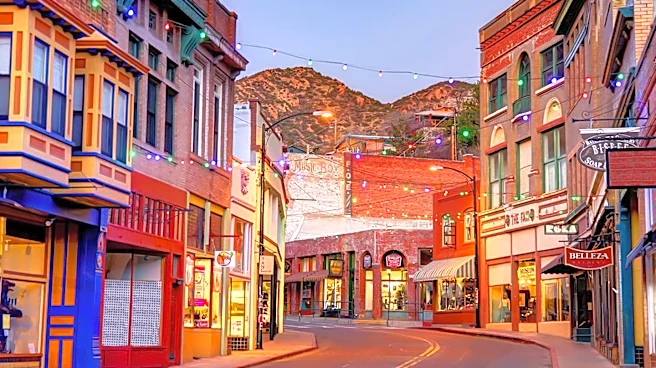
Old, and Eureka. After fires in the 1860s destroyed original wood-frame structures, the town was rebuilt with brick and local greenstone, featuring shops and storefronts with verandas. Mining operations, including the Central Eureka Mine, continued until 1953 when it closed due to fixed gold prices and rising operational costs. This closure, coupled with a Highway 49 bypass routing traffic away, halted further development, effectively preserving the town's 19th-century architecture and character. Notable surviving structures include the 1859 Sutter Creek Inn, the 1865 Masonic Hall, the 1873 Historic Knight Foundry, and the 1896 Monteverde General Store Museum.
Why It's Important?
The preservation of Sutter Creek offers a unique window into the American Gold Rush era, providing tangible historical context for understanding the economic and social dynamics of that period. The town's unchanged landscape serves as a living museum, illustrating how mining booms shaped communities and how their decline could inadvertently freeze them in time. This historical integrity is significant for tourism, attracting visitors interested in U.S. history and the legacy of the Forty-Niners. Economically, the town's reliance on its historical charm for tourism highlights a shift from resource extraction to heritage preservation as a driver of local economies. The continued operation of sites like the Knight Foundry, the last water-powered foundry in the U.S., underscores the importance of industrial heritage and the skills associated with it.
What's Next?
Sutter Creek is expected to continue leveraging its historical appeal to attract tourists and history enthusiasts. Efforts will likely focus on maintaining the integrity of its historic district and promoting its unique heritage sites. The town's visitor center offers self-guided walking maps, encouraging exploration of its 1860s buildings, which now house local businesses like bakeries, antique shops, and wine tasting rooms. Events such as the monthly demonstrations at the Knight Foundry, where 19th-century water wheels are fired up, will continue to draw visitors and educate the public on historical industrial processes. The town's location along the Golden Chain Highway positions it as a key stop for road trips through California's historic small towns.
Beyond the Headlines
The story of Sutter Creek reflects a broader narrative in the U.S. about the evolution of industrial towns and the unexpected benefits of economic stagnation in preserving historical sites. It raises questions about the balance between modernization and historical conservation, and how communities can find new identities after their primary industries fade. The town's ability to thrive as a historical destination, rather than succumbing to decay or extensive redevelopment, offers a model for other communities grappling with similar post-industrial challenges. It also highlights the cultural value of tangible history, allowing future generations to experience and learn from the physical remnants of past eras, particularly one as transformative as the California Gold Rush.