

What's Happening?
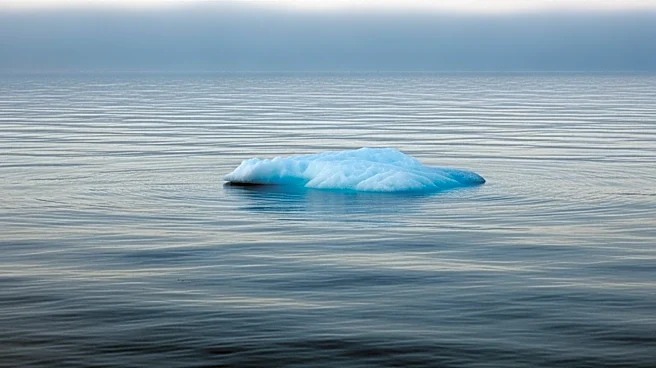
Recent research has identified the causes behind the sudden decline in Antarctica's sea ice, which began in 2016 after decades of expansion. The study, led by Earle Wilson, a polar oceanographer at Stanford University, highlights the role of ocean salinity,
winds, and water churn in this phenomenon. Using data from Argo floats, which measure ocean conditions, scientists discovered that increased precipitation had previously made surface waters fresher, trapping warmth in deeper layers. However, intensified winds have since churned up this warmth, contributing to the sea ice's rapid decline. This change poses significant risks to the Antarctic ice sheet, which could drastically raise global sea levels if it melts.
Why It's Important?
The decline in Antarctic sea ice has far-reaching implications for global sea levels and climate patterns. The ice sheet, supported by floating ice shelves, is crucial in maintaining current sea levels. As these shelves weaken due to warming seas, the potential for accelerated ice sheet melting increases, threatening coastal regions worldwide. The study underscores the urgent need for enhanced monitoring and international cooperation to understand and mitigate these changes. The findings also contribute to refining climate models, which are essential for predicting future environmental shifts and informing policy decisions.
What's Next?
The research community is focused on expanding observational networks in the Antarctic region to better monitor oceanic and atmospheric changes. This effort is critical for improving climate models and understanding the long-term trends in sea ice behavior. Policymakers and environmental organizations may use this data to advocate for stronger climate action and adaptation strategies. The study also raises questions about the balance between natural variability and human-induced climate change, prompting further investigation into the underlying causes of these environmental shifts.