
What's Happening?
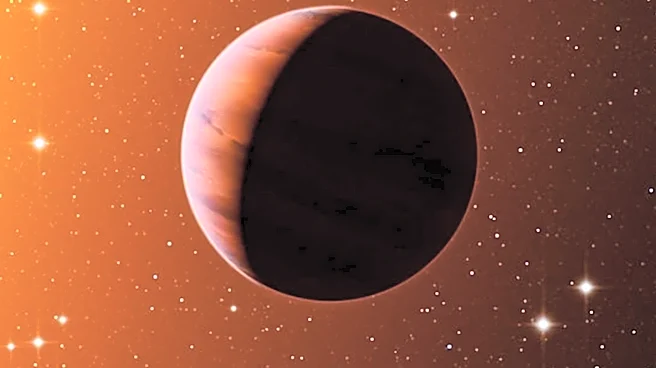
Scientists have confirmed the presence of an atmosphere on LHS 1140 b, a rocky planet located 48 light-years away in the constellation Cetus. This discovery was made by detecting helium escaping from the planet, which absorbs a specific band of its star's
light. LHS 1140 b orbits a cool red dwarf star and is situated within the habitable zone, where conditions might allow for liquid water. The planet is about 1.7 times the radius of Earth and 5.6 times its mass, classifying it as a super-Earth. The detection of helium provides evidence of atmospheric material, although the composition and conditions of the lower atmosphere remain unknown.
Why It's Important?
The confirmation of an atmosphere on LHS 1140 b marks a significant milestone in the search for habitable exoplanets. It demonstrates that rocky planets in habitable zones can retain atmospheres, a crucial factor for potential habitability. This finding encourages further exploration of LHS 1140 b to determine the presence of other gases and assess the planet's potential to support life. The study also highlights the capabilities of current astronomical instruments in detecting atmospheric features from distant worlds, paving the way for more detailed investigations using advanced telescopes like the James Webb Space Telescope.
What's Next?
Future observations will focus on characterizing the lower atmosphere of LHS 1140 b, including the search for water vapor and other gases that could indicate habitability. Repeated helium transit observations will help understand the variability of the atmosphere and its interaction with the host star. These studies will contribute to a broader understanding of atmospheric dynamics on exoplanets and refine models predicting habitability. The scientific community will continue to monitor LHS 1140 b and similar exoplanets to gather more data and potentially identify biosignatures.