






What's Happening?
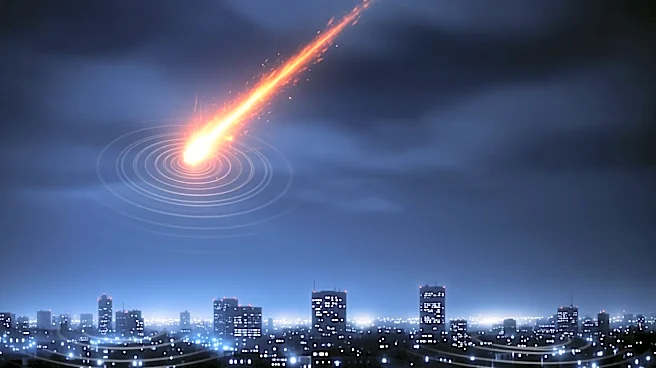
NASA has identified a meteor that landed in Cape Cod Bay as potentially being made of iron, with an unusually high density. The meteor, which entered the atmosphere over southern New Hampshire, broke apart at a high altitude of about 31 miles, producing
few fragments. These fragments, larger than typical meteorite pieces, are estimated to weigh from hundreds of grams to several kilograms. The meteor's density is estimated at 8,000 kilograms per cubic meter, consistent with iron meteorites, though this calculation is still experimental. Despite the potential for recovery, NASA has no plans to retrieve the meteorites due to the resources required and the contamination risk from the ocean.
Why It's Important?
The discovery of an iron meteor in Cape Cod Bay is significant for scientific research, as it provides an opportunity to study the composition and characteristics of meteors that enter Earth's atmosphere. Understanding the density and composition of such meteors can offer insights into their origins and the processes they undergo during atmospheric entry. The event also highlights the capabilities of radar technology in tracking and analyzing meteors, which can improve future detection and study of similar occurrences. The lack of plans for recovery underscores the challenges and costs associated with retrieving meteorites from oceanic environments.
What's Next?
While NASA has no current plans to recover the meteor fragments, the event may prompt further research into the feasibility and scientific value of such recoveries. The data collected from this meteor could be used to refine models of meteor entry and fragmentation, potentially aiding in the prediction and analysis of future meteor events. Additionally, the scientific community may explore alternative methods for studying meteors that land in inaccessible locations, such as remote sensing or advanced simulation techniques.