
What's Happening?
The James Webb Space Telescope (JWST) has made significant strides in understanding the formation of supermassive black holes. Since its deployment, JWST has captured deep images of the cosmos, revealing
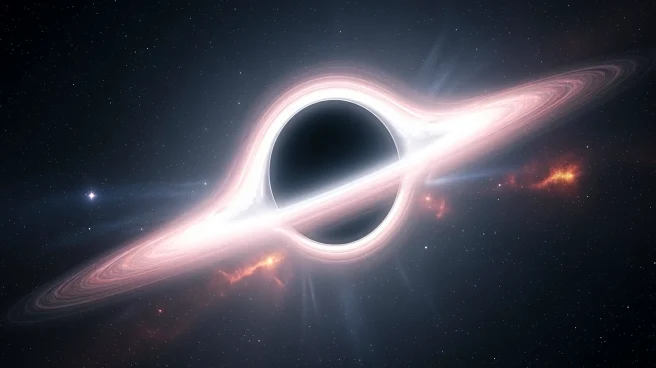
mysterious 'little red dots' that puzzled astronomers. Initially thought to be dwarf galaxies or dense star clusters, these luminous objects defied existing cosmological models. Recent analyses suggest these dots are 'black hole stars,' indicating the birth of supermassive black holes within dense gas clouds less than a billion years after the Big Bang. This discovery challenges previous assumptions about black hole formation, suggesting they may originate from direct gravitational collapse or the merger of stellar-mass black holes within gas clouds.
Why It's Important?
This discovery is pivotal for astrophysics, as it reshapes the understanding of black hole formation and the early universe. The identification of 'black hole stars' provides a new perspective on how supermassive black holes, which anchor galaxies, come into existence. This could lead to revisions in cosmological theories and models, impacting how scientists interpret the evolution of galaxies and the universe. The findings also highlight the capabilities of the JWST in uncovering phenomena that were previously beyond the reach of existing telescopes, marking a significant advancement in space exploration and observational astronomy.
What's Next?
Astronomers will continue to analyze data from the JWST to confirm these findings and explore the implications further. Future observations may focus on identifying more 'black hole stars' and understanding their role in galaxy formation. The scientific community is likely to engage in discussions and research to integrate these new insights into existing cosmological frameworks. Additionally, the JWST's ongoing mission will continue to provide data that could lead to further groundbreaking discoveries in the field of astronomy.
Beyond the Headlines
The discovery of 'black hole stars' raises questions about the nature of the early universe and the processes that led to the formation of the first galaxies. It challenges the notion of a static cosmological model, suggesting a more dynamic and complex early universe. This could influence future research directions, encouraging scientists to explore alternative theories of cosmic evolution. The findings also underscore the importance of advanced observational tools like the JWST in pushing the boundaries of human knowledge about the universe.