



What's Happening?
A new study indicates that over three-quarters of Indo-Pacific coral reefs may not be able to grow fast enough to keep pace with projected sea-level rise, leading to their potential submergence. Researchers from Nanyang Technological University (NTU)
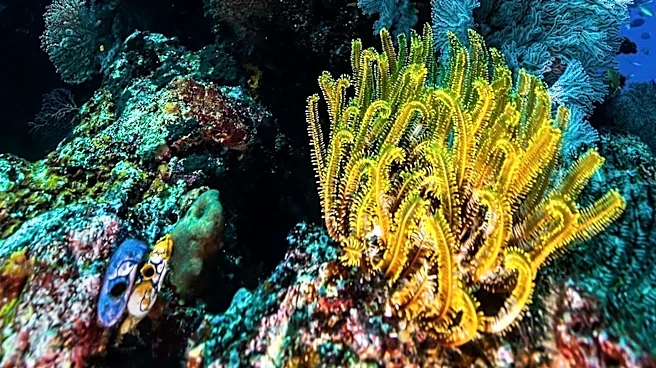
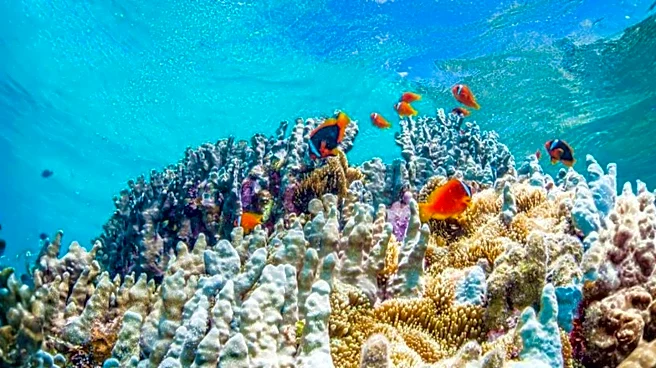
in Singapore found that 76% of surveyed reef sites lack the capacity to maintain upward growth under a high greenhouse gas emissions scenario. The study, published in Nature Communications, identified a critical tipping point: if relative sea level rises by more than 5.3mm per year, there is a greater than 90% chance reefs will be unable to sustain their growth. Current trends suggest this threshold could be crossed within 35 years unless significant reductions in emissions occur. Historically, coral reefs have kept pace with rising seas by building themselves upward through calcium carbonate production, which keeps them close to the surface for sunlight and wave protection. However, if sea levels rise too quickly, reefs become progressively submerged, losing their shallow, complex structures.
Why It's Important?
The potential submergence of Indo-Pacific coral reefs carries significant implications for coastal protection and marine ecosystems. Healthy coral reefs absorb 97% of wave energy before it reaches land and can reduce wave height by over 75%, according to a global meta-analysis. The loss of these natural barriers would increase the risk of coastal erosion and flooding for low-lying islands and tropical coastlines, impacting millions of people and critical infrastructure. Furthermore, the complex structures of coral reefs provide essential habitats for a vast array of fish and other marine life. Their degradation would lead to a reduction in biodiversity, negatively affecting fisheries, tourism, and the livelihoods of coastal communities that depend on these ecosystems. The study highlights the urgent need for global action on greenhouse gas emissions to mitigate these severe environmental and socio-economic consequences.
What's Next?
The study underscores the immediate need for substantial cuts in greenhouse gas emissions to prevent coral reef submergence. Without such reductions, the critical sea-level rise threshold is projected to be crossed within 35 years, leading to widespread reef drowning. This will necessitate increased focus on international climate agreements and policies aimed at reducing carbon footprints. Coastal communities and governments in the Indo-Pacific region may need to develop and implement adaptation strategies to cope with increased coastal erosion and flooding risks, such as investing in artificial barriers or relocating vulnerable populations. Further research into coral resilience and potential interventions to accelerate reef growth could also become a priority, though the primary focus remains on mitigating the root cause of accelerated sea-level rise.
Beyond the Headlines
The impending crisis for Indo-Pacific coral reefs extends beyond immediate environmental and economic impacts, touching upon cultural heritage and global ecological balance. Many coastal communities have deep cultural ties to coral reefs, relying on them for sustenance, traditional practices, and spiritual significance. Their loss would represent an irreplaceable cultural void. Ecologically, coral reefs are often referred to as the 'rainforests of the sea' due to their immense biodiversity. Their degradation could trigger cascading effects throughout marine food webs, potentially leading to the collapse of various species populations and disrupting oceanic ecosystems far beyond the Indo-Pacific. This situation also highlights the interconnectedness of global climate patterns and local ecological health, emphasizing that actions taken in one part of the world have profound consequences for distant ecosystems and human populations.