
What's Happening?
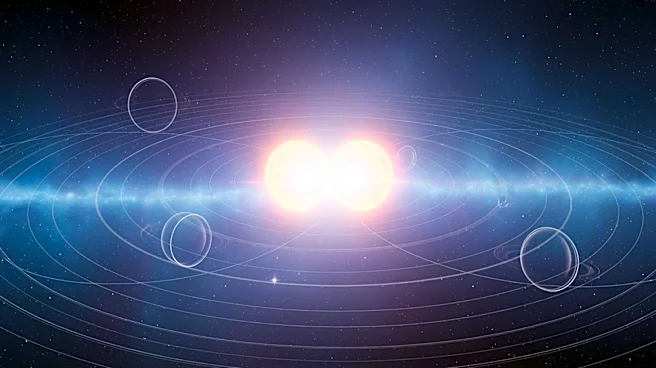
Astronomers have identified 27 new potential circumbinary planets, which orbit two stars, using data from NASA's Transiting Exoplanet Survey Satellite. This discovery significantly increases the number
of known circumbinary planets, previously only 18, compared to over 6,000 planets orbiting single stars. The planets are located between 650 and 18,000 light years from Earth. The research, published in the Monthly Notices of the Royal Astronomical Society, highlights the use of 'apsidal precession' to detect these planets, a method that identifies wobbles in the orbits of binary stars. This technique allows scientists to infer the presence of a third body, potentially a planet, in the system. The study's senior author, Associate Professor Ben Montet, notes that the discovery aligns with the iconic image of a planet with two suns, popularized by the Star Wars universe.
Why It's Important?
The discovery of these circumbinary planets is significant as it expands our understanding of planetary systems beyond our own solar system. These planets, with their unique orbits around two stars, present environments vastly different from those on Earth, offering new insights into planetary formation and stability. The findings could lead to further exploration of how such planets could support life, given their extreme environments. Additionally, the research demonstrates the effectiveness of new detection methods, which could uncover more planets in the future, enhancing our knowledge of the universe's diversity.