




What's Happening?
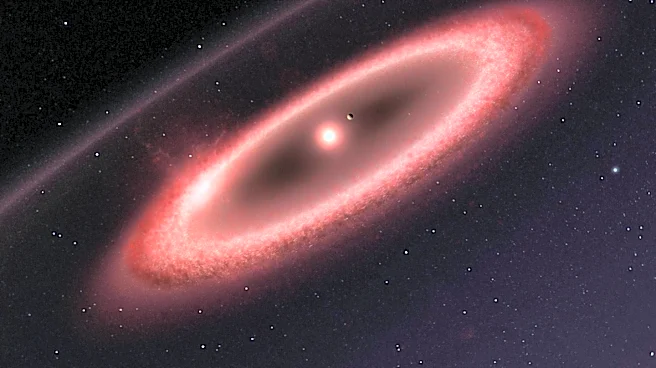
Astronomers have identified Elias 2-24 b, a 'baby' exoplanet orbiting a newly formed star approximately 450 light-years from Earth. This exoplanet is estimated to be less than 1 million years old, making it the youngest alien world ever discovered. Initial
signs of its existence were noted in 2017 as a gap in the star's protoplanetary disk, a swirling cloud of gas and dust where planets form. Researchers utilized observations from three major telescopes—the W. M. Keck Observatory in Hawaii, the Atacama Large Millimeter/submillimeter Array in Chile, and the European Southern Observatory’s Very Large Telescope—to directly image and confirm the exoplanet's presence. Elias 2-24 b is between two and four times the mass of Jupiter and orbits its star at nearly twice the distance Neptune is from the Sun. This discovery provides a unique opportunity to study the early stages of planet formation, a process rarely observed directly.
Why It's Important?
The discovery of Elias 2-24 b is significant because it challenges existing planet-formation models. Previous youngest exoplanets were around 5 million years old, and even those pushed the boundaries of current scientific understanding. Elias 2-24 b, being at least twice as young, suggests that some important processes in planet formation are still not fully understood. This finding offers scientists a rare chance to observe a planet actively accreting material from its surroundings, providing crucial data to refine and improve theoretical models of how planets, including our own, take shape. Understanding these early stages can shed light on the conditions necessary for planetary habitability and the prevalence of different types of planetary systems in the universe. The ability to directly image such a young exoplanet also highlights advancements in telescopic technology and data analysis, paving the way for future discoveries.
What's Next?
The ongoing study of Elias 2-24 b will continue to provide valuable data on planet formation. Future observations with advanced telescopes, such as NASA's soon-to-be-operational Nancy Grace Roman Space Telescope, are expected to further enhance our ability to detect and study young exoplanets. The Roman Space Telescope, equipped with a state-of-the-art coronagraph, will be able to block out the light from distant stars, making it easier to observe their surrounding protoplanetary disks and any forming planets within them. Experts anticipate that Roman could discover up to 100,000 new exoplanets, with a reduced bias towards older planets, meaning many more planetary infants like Elias 2-24 b could be found. This new era of discovery will likely lead to a more comprehensive understanding of planetary evolution and the diversity of exoplanetary systems.
Beyond the Headlines
The detection of Elias 2-24 b has broader implications for the search for extraterrestrial life. By understanding the conditions and timelines of planet formation, scientists can better target exoplanets that might harbor life. The fact that planet formation can occur so rapidly in a star's early life suggests that habitable conditions could arise much sooner in a stellar system's history than previously thought. This discovery also underscores the dynamic and complex nature of protoplanetary disks, which are not merely passive reservoirs of material but active sites of gravitational clumping and planetary accretion. The ongoing refinement of planet-formation models based on observations like Elias 2-24 b will ultimately contribute to a more complete picture of cosmic evolution and our place within it.