








What's Happening?
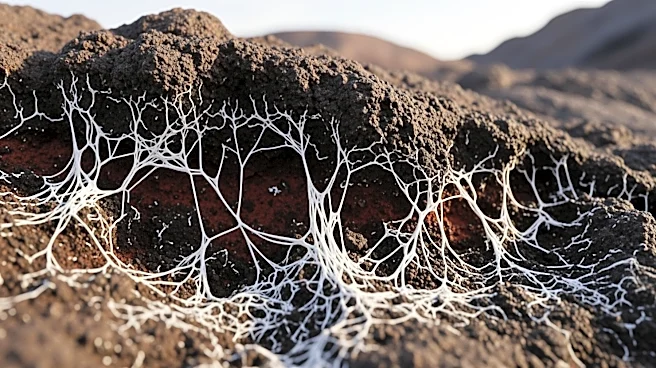
Recent research published in the journal Frontiers in Astronomy and Space Sciences suggests that certain fungi, such as trichoderma, could be instrumental in converting Martian regolith into soil capable of supporting plant life. The study highlights
the potential of these fungi to metabolize toxic elements present in Martian soil, such as aluminum and manganese, while producing essential nutrients like phosphates. Additionally, extremophile fungi like Cryomyces antarcticus, which have demonstrated resilience in harsh space conditions, could aid plant growth under environmental stress. This discovery could provide a viable alternative to traditional methods of soil enrichment, such as biofuel and human waste, as depicted in the sci-fi novel 'The Martian'. The research underscores the challenges of using Martian regolith, which is naturally high in alkaline pH and lacks vital nutrients, for agriculture.
Why It's Important?
The ability to transform Martian soil into fertile ground is crucial for sustaining human life on Mars, reducing the need to transport soil or other growing media from Earth. This could significantly lower the costs and logistical challenges associated with establishing a permanent human presence on Mars. The research also opens up possibilities for using similar techniques on the Moon, where regolith shares similar properties. The development of sustainable agricultural practices on Mars could pave the way for long-term space colonization, making it a critical step in humanity's exploration and settlement of other planets. Furthermore, the study of these fungi could lead to advancements in biotechnology and agriculture on Earth, particularly in improving soil health and crop yields in challenging environments.
What's Next?
Future research will need to address several questions, including the safety of consuming crops grown in Martian soil and their reaction to radiation exposure. Scientists will also need to validate these concepts in controlled environments before implementation on Mars. The development of algae-based fertilizers using Martian resources, as demonstrated by researchers at the University of Bremen and the German Aerospace Center, represents a promising step forward. Continued collaboration between international research teams will be essential to refine these techniques and ensure their viability for future Mars missions. As the scientific community progresses, these findings could influence policy decisions regarding space exploration and the allocation of resources for extraterrestrial agriculture.