
What's Happening?
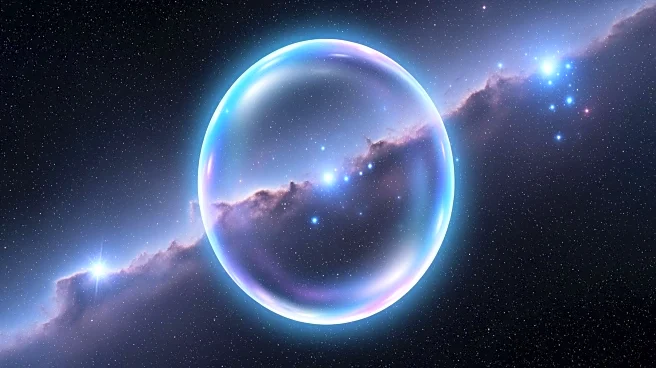
The Bubble Nebula, also known as NGC 7635, is an emission nebula located in the constellation Cassiopeia. It is characterized by a spherical shape formed by the interaction of a massive star's stellar wind with surrounding nebular material. The central
star, BD+602522, is 40 times more massive than the Sun and emits a wind moving at 4 million mph. This wind creates the bubble's surface, marking the boundary of the expanding gust front. The nebula's asymmetry is due to variations in the density of the surrounding gas. Discovered by Sir William Herschel in 1787, the Bubble Nebula is faint and requires specific observational conditions to be seen.
Why It's Important?
The Bubble Nebula offers a unique opportunity to study the interactions between stars and their surrounding environments. Understanding these interactions provides insights into the processes that shape nebulae and influence star formation. The study of such nebulae contributes to our knowledge of stellar evolution and the dynamics of the interstellar medium. Observing the Bubble Nebula helps astronomers learn more about the life cycles of massive stars and the impact of their winds on the surrounding space.
What's Next?
Astronomers will continue to observe the Bubble Nebula to gain a deeper understanding of its structure and the forces at play. Future studies will focus on the detailed analysis of the nebula's composition and the dynamics of the stellar wind. These observations will enhance our understanding of the complex interactions between stars and their environments, contributing to the broader field of astrophysics.