







What's Happening?
A small marine salvage company, Jessop Marine Recoveries, led by Keith Jessop, successfully recovered 460 out of 465 gold bars from the sunken British World War II cruiser HMS Edinburgh. The ship, carrying five tons of gold as payment from the Soviet
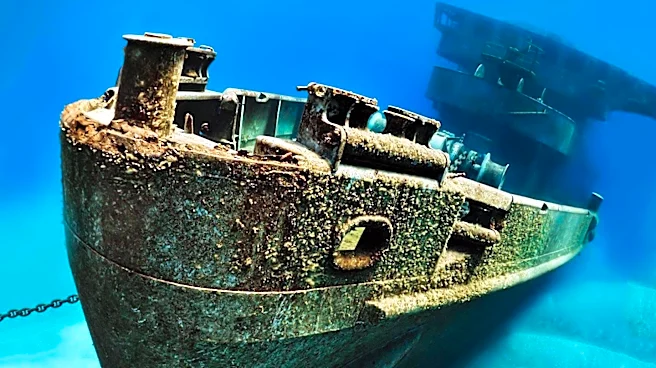
Union for wartime supplies, was torpedoed by a German submarine U-456 in April 1942 and subsequently scuttled in the Barents Sea, 800 feet below the surface. For nearly 40 years, the gold remained at the bottom of the ocean. Jessop spent years researching historical naval records and survivor accounts to pinpoint the wreck's location. In May 1981, his team located the HMS Edinburgh using powerful sonar and echo sounders. The recovery operation, which began in September 1981, involved specialized saturation divers who had to cut through four inches of steel armor to access the gold, as the original torpedo damage was blocked by wreckage. The divers worked in challenging Arctic conditions, using advanced equipment and techniques, including a gas-recovery system, which was a first for a commercial diving operation.
Why It's Important?
The successful recovery of the gold from the HMS Edinburgh represents a significant achievement in marine salvage history, demonstrating the capabilities of advanced diving technology and meticulous research. The gold, valued at approximately $716 million today, was a crucial wartime payment, and its recovery, even decades later, highlights the enduring value of such assets. This operation also underscores the complexities and dangers involved in deep-sea recovery, particularly from designated war graves, which require careful and respectful approaches to avoid disturbing the site. The story serves as a testament to human ingenuity and perseverance in overcoming extreme environmental and technical challenges. Furthermore, it showcases the evolution of commercial diving and salvage techniques, pushing the boundaries of what was considered possible at the time.
What's Next?
While 460 of the 465 gold bars have been recovered, five bars remain unaccounted for within the wreck of the HMS Edinburgh. It is uncertain if further recovery efforts will be mounted for these remaining bars, given the extreme conditions and the passage of time since the last expedition in 1986. The site remains a war grave, which adds a layer of ethical consideration to any future endeavors. The recovered gold has likely been integrated into national reserves or sold, with proceeds distributed according to agreements made at the time of the salvage. The story of the HMS Edinburgh and its gold will continue to be a notable chapter in maritime history and a case study for future deep-sea salvage operations, particularly those involving historical wrecks and valuable cargo.
Beyond the Headlines
The recovery of the HMS Edinburgh's gold touches upon several deeper implications beyond the immediate financial and technical aspects. Ethically, the operation navigated the delicate balance between recovering valuable assets and respecting the site as a war grave, where 58 crew members lost their lives. The decision to avoid explosives and carefully cut through the ship's hull reflects a conscious effort to minimize disturbance. Culturally, the story reinforces the enduring allure of sunken treasure and the human drive to reclaim what is lost to the sea, often against incredible odds. It also highlights the historical significance of such wrecks, not just as repositories of wealth, but as tangible links to past conflicts and the sacrifices made during wartime. The technological advancements spurred by such challenging projects have broader applications in underwater exploration, engineering, and resource recovery, pushing the boundaries of human capability in extreme environments.