







What's Happening?
Archaeologists have developed a novel method to train deep learning models for identifying archaeological sites, particularly when real-world examples are scarce. Instead of relying on extensive collections of known sites, the team created simulated archaeological objects
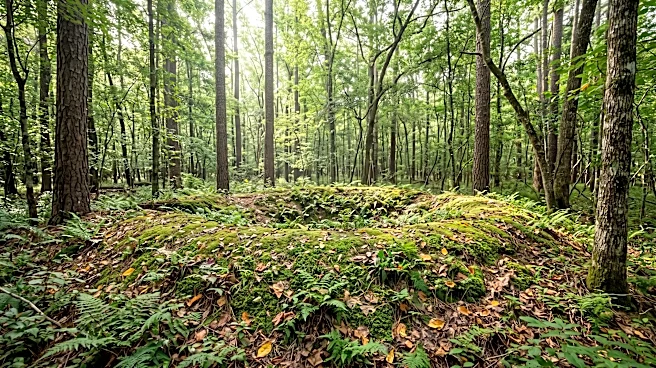
and integrated them into real lidar terrain data. This approach was applied to investigate 12 unusual circular structures in Kisatchie National Forest, Louisiana. Initially, these structures resembled historic tar kilns, but their unique shape presented a challenge for traditional machine learning models trained on existing tar kilns. The researchers trained Mask R-CNN models using tiled lidar images, with 80% for training, 10% for validation, and 10% for testing, over 15 rounds. While the models successfully identified many known targets and additional objects for further study, they also produced numerous false positives, often confusing the structures with natural formations or drainage features. Subsequent fieldwork, including auger tests, revealed no evidence of charcoal-rich deposits or other indicators typical of tar kilns. Instead, the structures' location near a former World War II military training site and their specific shape led the team to conclude they were likely howitzer emplacements, as suggested by a wartime training manual.
Why It's Important?
This innovative application of AI in archaeology represents a significant step forward in overcoming limitations associated with scarce training data. By demonstrating the effectiveness of simulated archaeological objects for training deep learning models, researchers can potentially accelerate the discovery and identification of previously unknown or misidentified historical sites. This method offers a more efficient preliminary screening process, allowing archaeologists to narrow down vast landscapes to specific areas of interest, thereby saving considerable time and resources compared to traditional pedestrian surveys. The ability to quickly generate simulated training data, as opposed to the time-consuming manual labeling of real sites, could revolutionize how archaeological surveys are conducted. While field verification remains crucial, AI's enhanced capability to detect unusual shapes and patterns in lidar data provides a powerful tool for initial assessment, ultimately contributing to a more comprehensive understanding of historical land use and human activity in the U.S. and beyond.
What's Next?
The research team suggests that these AI models could be utilized as a preliminary step before detailed image marking or extensive field surveys. Future efforts will likely focus on creating larger simulated datasets with thousands of objects to further enhance the accuracy and reduce the false positive rates of these models. Continued refinement of filtering techniques will also be essential to distinguish genuine archaeological features from natural formations or modern disturbances more effectively. The success of this method in identifying the true nature of the Kisatchie National Forest structures as potential howitzer emplacements highlights the importance of interdisciplinary approaches, combining AI analysis with historical military records and on-the-ground verification. This integrated strategy could lead to the discovery and reinterpretation of numerous sites across the U.S., particularly in areas with complex historical land use, such as former military training grounds or industrial sites.
Beyond the Headlines
The study's findings extend beyond mere archaeological discovery, touching upon the broader implications of AI in scientific research and the ethical considerations of its application. The initial misidentification of the structures as tar kilns, later corrected through fieldwork and historical context, underscores the critical role of human expertise and ground-truthing in conjunction with AI analysis. While AI can efficiently process vast amounts of data and identify patterns, it lacks the contextual understanding and interpretive capabilities of human researchers. This case exemplifies a collaborative model where AI acts as a powerful assistant, guiding human investigation rather than replacing it. Furthermore, the development of simulated training data opens up new avenues for research in fields where real-world data is limited or difficult to obtain, potentially accelerating discoveries in various scientific disciplines. The ethical dimension lies in ensuring that AI tools are used to augment human understanding, not to generate definitive conclusions without rigorous verification, especially when dealing with historical and cultural heritage.